
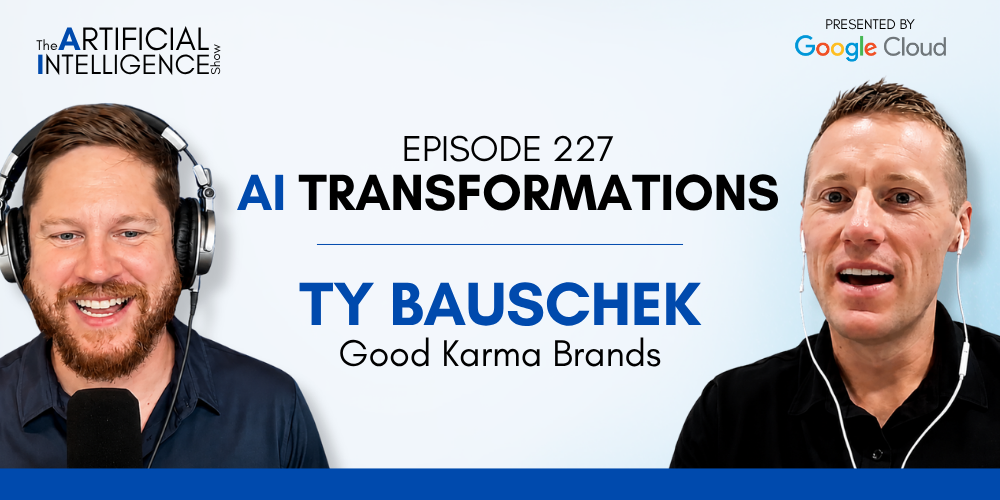
Good Karma Brands handed ChatGPT Enterprise to every full-time teammate on Labor Day and, less than a year later, 65% of the company uses AI every single day.
Senior Director of Innovation Ty Bauschek joins Mike Kaput to explain how they got there: a 50-person pilot, seven straight Tuesdays of onboarding, and group chats where each new cohort learned from the last.
This is the first episode of our AI Transformations series, presented by Google Cloud, and it's a rare look at what company-wide adoption actually takes: not a mandate memo, but a founder who made himself the engine and a culture that treats trying and failing as part of the job.
Listen or watch below—and see below for show notes and the transcript.
Listen Now
Watch the Video
Timestamps
00:01:00 — Introducing the AI Transformations Series
00:04:11 — Meet Ty Bauschek and Good Karma Brands
00:06:22 — Why AI became an urgent, top-down priority
00:08:23 — The rollout: a 50-person pilot and seven Tuesdays
00:10:17 — The tools: ChatGPT Enterprise, Claude, Codex
00:11:34 — How adoption evolved
00:13:43 — Use-case spotlight
00:18:09 — Driving real adoption, not shallow use
00:20:13 — Hitting 65% daily usage: training & the newsletter
00:22:42 — Building an innovation department & the "Cam" breakthrough
00:25:52 — How the innovation specialist role works day to day
00:29:33 — Deciding where to focus & freeing up partner time
00:32:41 — What's next & Ty's advice for other companies
This episode is presented by Google Cloud:
Google Cloud is the new way to the cloud, providing AI, infrastructure, developer, data, security, and collaboration tools built for today and tomorrow. Google Cloud offers a powerful, fully integrated and optimized AI stack with its own planet-scale infrastructure, custom-built chips, generative AI models and development platform, as well as AI-powered applications, to help organizations transform. Customers in more than 200 countries and territories turn to Google Cloud as their trusted technology partner.
Learn more about Google Cloud here: https://cloud.google.com/
Read the Transcription
Disclaimer: This transcription was written by AI, thanks to Descript, and has not been edited for content.
[00:00:00] Ty Bauschek: I always look at it from that perspective of, is it easier to teach our processes as someone who's AI native and AI hungry, or teach somebody who knows our processes how to use AI? And honestly, right now we're seeing that people who are AI hungry and curious and generalists are actually able to pick up our workflows easier than, conversely, teaching people how to use ai, who are in the workflows every day.
[00:00:21] Mike Kaput: Welcome to AI Transformations, a special series from the Artificial Intelligence Show. I'm Mike Kaput, chief Content Officer at SmarterX and Marketing AI Institute, and I'll be your host. Every business's AI journey looks different.
[00:00:35] In each of these episodes, I sit down with leaders who have lived through real AI transformation, including the actual stories, the pain points that push them to. Act the moment things started to click and the results they can point to today. So join us as we accelerate AI Literacy for All as part of our AI transformations [00:01:00] series.
[00:01:00] Introducing the AI Transformations Series
[00:01:00] Mike Kaput: Welcome everyone to episode 227 of the Artificial Intelligence Show. I am Mike Kaput, co-host of the Artificial Intelligence Show and Chief Content Officer here at SmarterX. Now, you may have guessed today's episode is a little. Different than your regularly scheduled programming. This is one of the episodes we are doing as part of a special limited series we're running called AI Transformations presented by Google Cloud.
[00:01:30] Now, in this special series, we are actually spotlighting how real companies are driving real change using ai. So in each episode. We're going to explore how leaders at some of the world's most innovative companies are actively using AI to transform how their teams, departments, or entire organizations work.
[00:01:50] We're going to actually look at what sparked the transformation, what work looked like before AI. How their journeys unfolded, what got messy along the way, and what results AI [00:02:00] is starting to unlock for businesses. And we are actually going to do that by interviewing those leaders firsthand right here on the show, including a leader.
[00:02:09] I've got here with me today, Ty Bauschek from Good Karma Brands. Much more on Ty in a minute. Now, the reason we're doing this series in partnership with our good friends at Google Cloud is simple. AI transformation can feel pretty abstract. We see everyone talking about it, but far fewer people are showing what it actually looks like in practice inside real companies with real teams facing real constraints.
[00:02:36] The goal of all these episodes is to make AI transformation much more concrete. We want you to hear how other leaders are approaching it, what they're learning, what they would do differently. And what practical lessons you can apply as you think about AI inside your own organization. And don't worry if you're a regular podcast listener.
[00:02:56] Me and Paul will still be doing our regular weekly [00:03:00] episode of the Artificial Intelligence Show. Paul and Cathy will still be doing their periodic AI answer episodes that they do here and there, so nothing changes except you get more episodes of the Artificial Intelligence Show. Thanks to this series.
[00:03:15] Before we dive into today's conversation, today's episode is brought to you by Gemini Enterprise. Now, businesses of every shape and size are turning to ai. They're learning how to move faster, do more, and improve their performance. But you cannot just hand your data over to any platform. You need a trusted partner.
[00:03:36] With years of experience. That's where Gemini Enterprise comes in. Gemini Enterprise helps you build sophisticated AI agents that can connect with your business data while also keeping it protected by world-class security and government. So no more compromising between performance and protection. So go get started with Gemini Enterprise today at [00:04:00] cloud.google.com/gemini-enterprise
[00:04:04] That's. cloud.google.com/gemini-enterprise
[00:04:11] Meet Ty Bauschek and Good Karma Brands
[00:04:11] Mike Kaput: Alright, so let's get into today's episode. So today we are talking with Ty Bauschek, who is the Senior Director of Innovation and Sales Development at Good Karma Brands. Good Karma Brands is a Milwaukee-based sports media marketing company that operates at the intersection of sports and local news.
[00:04:31] Audio, video, digital, and live events. The company has more than 550 employees and works across major sports, media, brands, and markets. That includes places like ESPN Digital, ESPN Radio Network and Podcasts, and local ESPN-affiliated brands in cities like Milwaukee, Chicago, Cleveland, Los Angeles, New York, Madison, and West Palm Beach.
[00:04:55] So Ty is here because Good Karma is in the middle of an [00:05:00] intense and urgent company-wide AI transformation. So in less than a year, Good Karma has rolled out AI tools broadly across the organization to hundreds of employees. They've invested heavily in AI literacy and started reinventing how work gets done using AI tools, and as a result, the company is actually seeing a 65% daily AI usage rate across the organization.
[00:05:26] Now, even though it's still early in the transformation, Good Karma is already seeing AI have a meaningful impact on day-to-day operations. For instance, one team member built an internal AI assistant that gets hours of work done in under a minute. Other teams are using AI to automate sales support.
[00:05:44] Follow-ups and operational tasks that together used to take dozens of hours each month. And now Good Karma is taking its next big transformational step with AI. They're creating dedicated innovation specialist roles that are focused full-time [00:06:00] on finding manual workflows across the company and using AI to improve or reinvent them, and scaling those solutions across the business now.
[00:06:09] Ty, welcome to the show. Really appreciate you being here.
[00:06:13] Ty Bauschek: Appreciate you having me. Big fan of all that you guys do
[00:06:16] Mike Kaput: Well, we're big fans of yours as well over at Good Karma. So let's dive right in here and start at the beginning.
[00:06:22] Why AI Became an Urgent, Top-Down Priority
[00:06:23] Mike Kaput: Maybe walk me through what made AI become such an urgent company-wide priority at Good Karma Brands.
[00:06:30] Ty Bauschek: Yeah. And to me, this is a pretty simple answer. It all starts with our founder and CEO, Craig Karmazin. We have a monthly all-team meeting, where we normally go over what happened that month on the content side, how are sales doing any teammate changes? And about a year ago around this time, Craig alluded to a big upcoming initiative that it was gonna be.
[00:06:51] One of the three largest things we have ever done. in 2002, when we decided to become a sports company, 2015, when we shifted to [00:07:00] handling some of ESPN Digital, and then now moving forward, we are gonna be an AI-forward, you know, frontier Company. And Craig really is the engine behind all of this.
[00:07:10] He took it upon himself too. Do research and figure out what the best LLM we could use. He was testing Copilot, ChatGPT, Claude, and he also, around that time, determined that we needed to start trying to build some of the software we were relying on. So around last year, labor Day, we not only hired two senior software engineers, but we also gave every full-time teammate ChatGPT enterprise accounts.
[00:07:34] Mike Kaput: Wow. So it sounds like that urgency and communication came straight from the top.
[00:07:38] Ty Bauschek: Straight from the top, company-wide call reiterated frequency over and over again. And you know, I laugh at times as you guys talk on the podcast or we look at the AI-driven leader books is that, you know, you need to have executive buy-in in order for change to really happen.
[00:07:53] And it's almost the opposite here, where the executive was telling we need to have change. And he, you know, really is leading [00:08:00] it, driving it and being the engine. And he, you know, introduced this show, you know, the artificial intelligence show. to the company. So if you saw last year around July, a couple uptick of a couple hundred listeners, it was because he showed it and highlighted some of the comments you had had told us, listen to the podcast, and that this is the, the journey we were headed on.
[00:08:18] Mike Kaput: That's awesome. So it sounds like things are moving pretty quick over there because you know, that wasn't that long ago.
[00:08:23] The Rollout: a 50-Person Pilot and Seven Tuesdays
[00:08:23] Mike Kaput: So I'm curious if you could maybe walk us through, spend some time talking through this initial rollout. So once AI became this urgent priority, how did Good Karma start getting and rolling out tools, training, support, and ushering employees through this AI transformation?
[00:08:42] Ty Bauschek: Yeah, we determined that, you know, probably handing over 400 licenses at one time was gonna be a lot. So we did have a pilot group start the Tuesday after Labor Day of about 50 teammates. They spent, the time in ChatGPT Enterprise; we had weekly connects. What were we using? We [00:09:00] had group chats and Microsoft Teams.
[00:09:01] Just, what was going well? What are we running into really crowdsourcing it. And at the end of the month, we determined that this was something that we needed company-wide. For the next seven Tuesdays we gave 50 teammates alphabetically accounts. And it was really funny 'cause they would ask me, where am I at on the threshold?
[00:09:18] Am I gonna get the account this Tuesday? And for seven consecutive Tuesdays we did kickoff calls where Craig was talking about the importance of AI. We were demoing things that people were seeing success with already. We were going over our AI policies. The do's and don'ts. And then from there, once they got their accounts, we put everyone in a, a group chat.
[00:09:37] So at one point we had eight consecutive group chats of 50 teammates troubleshooting, asking questions. And what we were seeing is that the earlier groups were at a disadvantage, because by the time it got to five or six sessions in those group chats that had started were asking questions. And we were actually able to go ahead and answer those questions ahead of time.
[00:09:56] Of, Hey, group three found out that you were running into the issues with. [00:10:00] Connectors here. Here's how you set up connectors and Group six was already further ahead than Group Five was at that point.
[00:10:06] Mike Kaput: Okay, so it sounds like this kicked off extremely fast. So that first group of 50, and then every week after that, 50 more. Can you talk to me about what AI tools people are actually getting access to
[00:10:17] The Tools: ChatGPT Enterprise, Claude, Codex
[00:10:17] Mike Kaput: When you're talking about what your, you know, connectors, what platforms people are looking at.
[00:10:21] Can you walk us through that?
[00:10:23] Ty Bauschek: Yeah, so every teammate has access to ChatGPT Enterprise, and through that we have our connectors to our Microsoft Suite. So we walk them through how to connect to their Outlook. Their calendars, their inboxes, our SharePoint, our Teams messages, and we were really walking them through how to connect it, how to get the best use out of it.
[00:10:43] So teammates were able to get that. At the time as well, we had found out that Claude was really, really good at helping with Excel. So we had our finance team, and a few teammates were working on the side with a Claude account as well, and comparing and contrasting. and then from there we had our senior software engineers were [00:11:00] running code with Claude Code.
[00:11:02] Codex, as they were building off. So software from there. So teammates were using it, experimenting with it, and a lot of the successes we have seen and we're seeing early on were coming from a grassroots, you know, it, everyone was innovating at the time and still are. And we were seeing a lot of successes with teammates finding it and sharing it and voicing it.
[00:11:20] And we were able to spread that company-wide.
[00:11:23] Mike Kaput: That's fantastic. So that kind of covers this initial Spark and the initial rollout. Maybe from there, could you walk us through the journey to where things stand today?
[00:11:34] How Adoption Evolved
[00:11:34] Mike Kaput: How has AI usage evolved across Good Karma? Since you initially rolled out the tools, answered the initial questions, and did the initial test, what is transformation look like inside the company now?
[00:11:46] Ty Bauschek: Yeah, and I actually had a pretty eye-opening moment. Last week, we had a teammate, John Martin, down in West Palm. He had just gotten back cancer-free after a year plus being away, and the first thing he put on my calendar was [00:12:00] AI education, and we got on the call on Friday, and he is like, I've never logged in before.
[00:12:05] I need you to walk me through how to use it. And that really hour-long span was really a great glimpse into, wait. We have come a far way. I, you know, we showed off a GPT that has access to MRI data, 33,000 lines of indexing. It used to take hours to go through. You're able to go and type in a meeting with an auto partner, provide auto indexing, snap of a finger.
[00:12:25] It came back, and he was mind blown. In my head, I go back to, wait, that was November. That took us a month to figure out. You just got that in a minute. And then I'm like, here's how to chat. Here's how to do a connector. So really, that shift has come from the successes staying, but we did make a shift a few months ago from looking and judging teammates based on usage to impact.
[00:12:46] Okay, we used to look at. What were the power scores? Are they using messages? Are they building GPTs? Are they using their connectors? How many tokens are they using? We were looking at it from that perspective. and then we started to realize maybe we just [00:13:00] have some chatty teammates, right?
[00:13:01] Maybe they're just messaging back and forth. And we shifted to the impact. Are we having more meetings with partners? Are we able to do what we do best every day? Are we able to automate a few of the workflows that we thought we could? We really shifted that mindset to what impact is AI having with us, and then how can we accelerate that impact rather than just usage, which was the message early on: use, use, use, see how it can, you know, reach for it, lean towards it.
[00:13:26] And now it has really shifted to obviously continue to use. Add it to your workflows, but we're really trying to break workflows at this point rather than layer in AI over an existing workflow.
[00:13:37] Mike Kaput: So maybe give the audience a sense, given that Good Karma has, you know, kinda your hands and so much interesting work,
[00:13:43] Use-Case Spotlight
[00:13:43] Mike Kaput: What kind of specific things was AI being used for?
[00:13:47] Gimme maybe an example of some of the use cases or functions that this is being deployed across.
[00:13:53] Ty Bauschek: Yeah, absolutely. I think the one that I, I'd point to right away is that from a sales support side. You know, we pride ourselves on customer [00:14:00] service. So, as you know, coming from the agency background is when you do commercials, those commercials have end dates on when you want that commercial to go.
[00:14:08] If it's an auto dealer, there are some rebates or some initiatives that may be done at the end of July or August. So we have something called a missing copier report. it lives in one of the systems that we use. Our partnership coordinators, which is sales support, would have to go in and manually pull the missing copier reports for the teammates that they supported.
[00:14:25] From there they would. Put it in an Excel file and then email it, and it would take up a lot of time for them to manually go in there. We had a sales support teammate go there has to be an easier way, and tried to automate it and was actually able to store that data from the software in MotherDuck, which is our data warehouse.
[00:14:43] And then from there was able to set up automations and an agent to go in and run it daily, figure it out. He built a dashboard, so now we have sales support teammates that have. Dashboards showing, hey, you have six missing copy reports or six missing copy coming up. [00:15:00] And we tested it, and we tried it, and now it's automated to the point where in Milwaukee teammates are getting emails sent directly to their inboxes of, here you have missing copy coming up in 48 hours, missing copy end, end of this week.
[00:15:12] This is one you can work ahead on. And it was saving teammates, you know, hours a week, you know, 10 to 15 hours a week at any point. Because we have 19 marketing consultants here in Milwaukee. You have to pull it for each individual. And now that we have that automated, you know, it has been a real success.
[00:15:27] And then from that. It actually shifted our mindset a little bit. We, you know, we have weekly AI connects. myself, one of the senior software engineers, Brett, chief of staff, Elizabeth, and then our CEO Craig we're in a meeting and I was like, I'm so excited for Max to be able to teach the other sales support teammates how to do this company-wide.
[00:15:46] You know, the trainings will set that up. And Brett came from an outside company and works for GKB and has made a real impact on us recently. And he said, why can't Maxis do it for the whole company? And that just really shifted and broke the mindset of what we were [00:16:00] doing. It was, wait, maybe we need to centralize some of these, some of these roles, some of these processes that we do.
[00:16:05] And that really sparked the interest. So that's one sales support example that we have of not only teammates leaning to AI, but also using it to automate and then. Thinking bigger.
[00:16:15] Mike Kaput: I mean, even one example of 10 to 15 hours a week per person is likely to have some people listening like drooling over those results.
[00:16:25] You can only hope you would get something like that as a result of AI adoption.
[00:16:29] Ty Bauschek: Absolutely, and the things that teammates were looking for were the mouse clicks. They were looking for the stuff that was taking away from doing the stuff they wanted to do. You know, nobody goes to school, or nobody wakes up to pull an Excel file to send out to somebody.
[00:16:42] So what we were trying to find and what this teammate was trying to find is, I'm best at meeting face-to-face with these teammates to help them out. I need to get away from the computer. How can AI automate the computer task work so I can do what I do best and meet with teammates face-to-face?
[00:16:56] Mike Kaput: I love that, and I love that you all are kind of our [00:17:00] inaugural episode for this series because this isn't just like taking one project or area of the company.
[00:17:04] This is true full-scale, fast-moving AI transformation by enabling, it sounds like, everyone in every role to be AI literate and empowered to find AI solutions to their own use cases.
[00:17:19] Ty Bauschek: Absolutely, and I do. You know, lay awake at night at times, trying to see how we can help every division. It feels like sales is the easiest one.
[00:17:26] Yeah. You know, Gina, you know, has really helped out on the marketing side, who's one of our innovation specialists. But the one that always keeps me up is, how can I help content? And one of the breakthroughs we had with content is we actually had, for each show, they created a project, they pulled their daily transcripts and had it act as an executive producer.
[00:17:45] And then what we're able to find from that standpoint too is it could take a list of topics and what direction should we take this, knowing what we like to do. And it was able to act as an executive producer in the Daily Show prep, so we're still trying to figure out ways to help the content team.
[00:17:59] There's [00:18:00] little, little, you know, inch at a time. But yes, it has been grassroots, every teammate trying to find innovation and optimization on a day-to-day basis.
[00:18:09] Driving Real Adoption, Not Shallow Use
[00:18:09] Mike Kaput: That's awesome. So, you know, I was curious as we hear about companies, you know, rolling out AI tools. It's, you kind of alluded to this, adoption can stay shallow even if you're giving people tons of different tools.
[00:18:23] It sounds like you all do not have that problem. So I'm curious what Good Karma did to encourage and support people to actually use AI in their day-to-day work? Because I'll admit, just from People we talk to in companies, we've seen you guys are moving very fast, and that's not always common to see everyone be immediately on board and come to you asking for help to actually get this stuff deployed.
[00:18:46] What have you been doing differently?
[00:18:48] Ty Bauschek: Yeah, it's absolutely the culture we've created of, you know, GKB is a team sport. That's one of the mottos that we have. All hands on deck. You know, we have a motto that everyone's in sales, meaning that from our [00:19:00] on-air team teammates to our sales support teammates, that everyone's contributing to the company's revenue in sales, and we're all moving that way.
[00:19:07] And it's the, the collaboration, the culture. We're fully in office, you know, five days a week. And I think that's led to a lot of things. I can walk around Milwaukee today and probably every other computer has chat open on a screen, and they're using it. It's the ability to allow people to fail, I think, is that aspect.
[00:19:25] And then it's the collaboration amongst team, and we're really highlighting it. We always say that a successful marketing campaign consists of frequency, message, and audience. From a frequency standpoint, we have added it to every company call that we have: marketing content, sales company-wide; you have to have an AI portion, h highlighting a teammate, how they're using AI, how have you used AI this week.
[00:19:48] And those are within our sales meetings, within our marketing meetings, as we're really keeping it top of mind. And then once we get. A sticky solution. We're just amplifying it and making sure this is the new process, [00:20:00] because we believe we've always done it this way as the most expensive words in business.
[00:20:05] So, we need to figure out what works better, so we can get back to being more partner facing, and then also doing what we do best every day.
[00:20:13] Hitting 65% Daily Usage: Training & the Newsletter
[00:20:13] Mike Kaput: And so you had mentioned this led to your measuring at the moment, 65% daily AI usage across the, what, 400-plus people that have licenses?
[00:20:24] Ty Bauschek: Yeah, it's 65%, and we go in, and you know, right now we're training on how to use it the best we can.
[00:20:31] I think like a lot of other companies in the world right now, we're running outta credits. And we're using it that way. So now we're coaching it on how to use it best, but. Yeah, we see some days it spikes, you know, we're up at 75%. Some days it's 65%. On a monthly basis, we're about 80-plus teammates that are logging in and using it.
[00:20:49] But I think that just goes to show that, you know, the teammates and the training and the AI education that we've, we've put in, and we're keeping it top of mind. We have a biweekly [00:21:00] newsletter that comes out every Tuesday. We just sent it out this morning, highlighting some of the new features that we have, tips and tricks, and highlighting teammates.
[00:21:08] And then the other Tuesday, so again, every other Tuesday we do AI trainings with Taylor and our company is showing tips and tricks, you know, getting ahead of thinking model, getting at a 5.6. What does this mean? This teammate really is doing a good job of ChatGPT plugin with Excel. Let's watch 'em demo it, and we're really showing these best uses, and we're keeping it top of mind.
[00:21:28] So, you know, it's, Hey, it's great. You know, I don't know if we'll ever get to a hundred percent. We may not wanna get to a hundred percent daily usage because we wanna make sure that, hey, if we're able to automate a marketing consultant's day-to-day, maybe they're out seeing partners, having lunches on the golf course, even, and they're away from their computer.
[00:21:46] So, we just wanna make sure that the impact we're seeing is increasing.
[00:21:50] Mike Kaput: And so just to reiterate, it sounds like biweekly newsletters showcasing what the team is doing biweekly in depth and like real-world trainings are helping [00:22:00] people see what's possible in these tools, and then also just a constant daily culture of experimentation and sharing what is working and what's not.
[00:22:09] Ty Bauschek: Absolutely, and I think that that culture of sharing and collaboration is what made it successful so far. And I seemed to be, you know, myself, I was at the middle of it as I would have teammates reach out with questions, and I was actually able to quarterback them, like, Hey, you should actually reach out to this teammate in Atlanta.
[00:22:24] They solved this; get time with them, and teammates were willing and able to do that. So it's just been a, you know, the culture that we've created of, you know, trying to improve, but it all, you know, stems from that: Hey, we, this is the engine. Craig's the engine. This is what we're trying to find. And that, that hunger that we're trying to see.
[00:22:42] Building an Innovation Department & the "Cam" Breakthrough
[00:22:42] Mike Kaput: So as AI usage is just taking off across the company, I'm curious if this has changed the way Good Karma is. Thinking about roles, responsibilities, how work works, has this led to any new roles, team changes, and [00:23:00] how you all are thinking about AI innovation?
[00:23:03] Ty Bauschek: Yeah. You know, you alluded to at the beginning, but we did.
[00:23:06] Create an innovation department. And with that, we created roles: innovation specialists. And with that, it really spawned from the fact that we had a few really hungry generalists, it always has talked about. A few really hungry teammates. And I'm gonna highlight Gina in New York here as she was a marketing design coordinator in new.
[00:23:27] Her role was to build campaigns that would go out to partners, and we put in a best practice of having our sales manager and marketing team review these campaigns before they went partner-facing. So every day before the four o'clock call, she would lock herself in a room, manually pull slides, pull this together, edit, go online, pull logos, and it would just take her two to three hours minimum to build a single campaign.
[00:23:49] And you know, at a peak in any given week, you're probably doing three or four campaigns a day. So that was just adding up, and she felt there has to be a better way. So she built through a GPT and [00:24:00] then ultimately Codex something that we called Cam, campaign assistant manager. It's also a nod to Cam Skattebo, who's the running back for the Giants.
[00:24:07] That's her, one of her favorite players. So she got that in there as well. And what she was able to do with this and the help of other teammates, was able to take almost like a menu, a la carte menu, and put it into, give it the file. Hit enter, and she had indexed a vault of every slide possible for New York.
[00:24:25] And it would go through and pull the slides, accumulate it. You could add the partner logo in. And there have been iterations of it. So the first time she demoed it to me of, Hey, I wanna show you something really cool. I've been working on, I thought it was a magic trick. I thought it was a rabbit-in-the-hat situation.
[00:24:39] Like, that can't be true. You're tricking me. Here's a new investment calculator. I see. We call it- I, I edited it. Let's see if it can do it. And it did it. They went, hold on. How long did that take you? Well, the building, no. How long did this campaign take you? 10 minutes. How long did it used to take you?
[00:24:55] Three hours. And I was like, all right. So then we [00:25:00] had some turnover in our Chicago office. She flew to Chicago and helped them build their version of cam. And then during our weekly meetings, we went and we proposed the idea to Craig. What if we created, under the engineers or under a department, these innovation specialists, that as opposed to them doing this part-time and seeing great success and innovation and optimization, what, what would they be capable of doing if this was their full-time job?
[00:25:24] And you know, that has started, and we have really, you know, leaned into them because they're in this position, because they look at their career description and as opposed to saying, what can I keep AI from touching, they went, what can AI do? That can get me to do the stuff I actually wanna do, which is be creative, which is help partners, which is be teammate facing.
[00:25:44] And through that, we have created the innovation specialist role. And just seeing the hunger within those teammates of what they're trying to solve already has been incredible.
[00:25:52] How the Innovation Specialist Role Works Day to Day
[00:25:52] Mike Kaput: That's so cool. I love that. Maybe could you give me a, a little more of a sense of how this role is going to work? I know it's very new, but [00:26:00]
[00:26:00] the innovation specialists, so they're going to function full time as people that help everyone within the company reinvent workflows, it sounds like with ai. What does that actually look like in practice?
[00:26:12] Ty Bauschek: Yeah, so we don't want to be a ticket-taking team. We don't want to have something set up, and we need to get to this.
[00:26:18] We really want them to embed themself in workflows, sit with teammates, try to figure out and solve what can be. And you know, right now, Max, coming from sales support, and Gina coming from marketing, is that they sat in those roles for so long, they knew the day-to-day. So they're able to troubleshoot and have the confidence to be able to go in and go, I know that I can make this better with ai.
[00:26:40] Let me take the lead with it. And then right now what they're struggling with is they have the. Autonomy and they have the ability to go and do this. They don't really have to act permission, ask permission, they can come to me with ideas. and then we built an innovation scorecard. so what we have in our weekly meetings is they will propose ideas for us to go and tackle.
[00:26:59] They need to [00:27:00] come to us with the innovation scorecard and what it graded out of 30. They then hand us a scorecard, we fill it out and then we have a GPT run it unbiased, and we compare. Does this meet our threshold of, of what we feel like we should be tackling? So right now I'm acting as the strategic filter.
[00:27:14] There's been so much excitement as we start to unroll, unveil this role that I'm taking, the excitement- I'm taking the requests and allowing them to really focus on what they're doing, and it's really just determining their bandwidth, right? They probably have just. The bandwidth to do one transformational project, a piece at the moment.
[00:27:32] And then there's probably incremental things that they can tackle pretty simply. But what we're also looking at is that they may not need to be in every situation is that they can embed themselves in a workflow and go, actually, you guys are in a pretty good position here. Keep going with it. Tap us if you need help.
[00:27:48] And then conversely, the situations they're running into now are that it's the first time they're in GitLab. And they're working on branching off projects on the back end of Cam that we need to tap on the senior software engineers. [00:28:00] And say, Hey, can we get a, can you guys get a peek at this? We need to add Microsoft authentication into this.
[00:28:04] We might need penetration testing on this. We've never done this before. Can you guys help? So it's really a collaboration; we don't wanna make it feel like we're a SWAT team going in and we're gonna disrupt what you do, right? We wanna be, Hey, if innovation specialists are here, this is- they're gonna help.
[00:28:21] Mike Kaput: It sounds like there's a real advantage to having internal teammates that you could elevate into this role. Am I right in saying that? I mean, obviously there's plenty of outside experts who could come in and help as well, but it sounds like having people who know the business already who've worked in the business is huge.
[00:28:38] Ty Bauschek: Yeah. We speak the same language, which is unbelievable. You know, it's, it's low-to-no code, especially now with Codex and Claude Code. Yeah. You really don't have to be living within that code. And the fact that there already have been teammates embedded in workflows and know what that looks like, I'm actually already nervous that if we are looking to expand this role, I don't think we can replicate what we [00:29:00] just did over the past year.
[00:29:01] Yeah. Because I don't think we would have success if we went out and got engineers or people, you know, fresh outta school, that this is their first role. But that doesn't mean that we can't find success with that. It just has been a perfect storm of they've been in a team, they've been a teammate, they're hungry, they have AI background, and they've embedded themselves in workflow.
[00:29:21] I think the real challenge for us will be when we have to tackle divisions that they haven't been in. So they need to kind of sit on those teams, learn the processes, and really take the time to see how we can help.
[00:29:33] Deciding Where to Focus & Freeing Up Partner Time
[00:29:33] Mike Kaput: So Ty, as the person kind of leading that new innovation team, I'm curious from your perspective at a high level, at a strategic level, how are you really deciding where to focus, what to build, how to take all these ideas and turn them into things that actually scale?
[00:29:51] That sounds like that's kind of the next phase here of this transformation.
[00:29:55] Ty Bauschek: That is the next phase, and I always am nervous, and I go to our senior software [00:30:00] engineer, Brett, and go, I just. What if we run out of ideas and he's like, you're never gonna run out of ideas. We're always gonna be able to do something.
[00:30:06] So to me, it's just always looking at the pain points. It's looking at the opportunities that, you know, we, I keep saying, allow us to do what we do best. We take the 12 questions that gauge the culture. And one of the questions is, I have the ability to do what I do best every day at work and for us.
[00:30:26] Nobody's best at accumulating slides. Nobody's best at figuring out this Excel to send to somebody or mass email. It's always partner-oriented. And, you've alluded to the AI for sales workshops of, you know, 30% of the time of sellers is actually facing partners or, or selling. Yep. And our, our job is how we can free them up?
[00:30:46] Can we get that to 45? Can we get that to 60? Can we get that to 75% of their time is partner facing? And you know, there is a world where. All of the roles here at GKB are partner facing, and are we gonna be ready for that? So, [00:31:00] you know, how are we able to take away the task-oriented work to keep the same quality, if not better quality, that we're able to have to allow teammates to collaborate more.
[00:31:07] So from a strategic standpoint. I just need to be their sports agent essentially. And go out and, hey, this is what he is good at. He is gonna, he's gonna go here, here's a project we're working on, here's how we're gonna use it. So for me, I've really just been a microphone of, Hey, these teammates have been doing it.
[00:31:23] But like I alluded to earlier today, everyone's in sales. I think everyone's still in innovation. And some of the best things that we're gonna have are gonna come from places we never thought. Our smallest location that we have is actually where we were founded is Beaver Dam, Wisconsin. Okay.
[00:31:38] And I was up there. We had our John Moser Children's Radiothon. I was meeting with a teammate. He was showing off a GPT he made, and it's saving him hours a day to accumulate new sites in DA in Dodge County and come up with what they were gonna talk about on that day-to-day basis. And he said, I just wish there was a way it could read this shared inbox that, you know, it could go in and get it.
[00:31:58] It just can't access it. And I was like, that [00:32:00] doesn't feel right. So we went back, we looked in the settings, and we turned it on. So his curiosity unlocked for the whole company now is that there are so many shared inboxes, receivables, payables that now we're training, Hey, if you have a shared inbox, you can set up a schedule to go and look at it and recap it for you.
[00:32:15] You don't have to go in there every day. It can summarize it before we even get here. And like that curiosity has led to an unlock of this. And I think that's where we're gonna succeed is just people continuing to show off what they do.
[00:32:27] Mike Kaput: That's fantastic. So as we wrap up our conversation here, Ty and I, I could talk about this for hours, honestly.
[00:32:34] Absolutely. I'm curious, this is still very early. You guys have made incredible progress, like.
[00:32:41] What's Next & Ty's Advice for Other Companies
[00:32:41] Mike Kaput: Maybe give us a sense of a little bit of what comes next for Good Karma, and also I'd be curious as to your thoughts here about what would you advise another company or tell another company that wants AI to become part of how people actually work every day?
[00:32:56] Because I'm sure we have a lot of listeners who are. [00:33:00] A little further behind in their AI transformation journey than Good Karma might be. So what can you share from kind of where you've been so far?
[00:33:08] Ty Bauschek: Yeah. You know, what's next for us is everything that we have been doing has been conceptual, and now it's becoming actual.
[00:33:16] We built a billing software. That's been in beta testing for us. And then next month we're planning on rolling it out to teammates. We have new software that we're planning on switching to, so we're gonna have to go everything conceptual if we're gonna be able to do this and be able to do that.
[00:33:31] You know, we actually have to get it off the ground and make sure it's being used. So what's that? What's next for us is that all the innovation, and I always use the word utopia, that I think we can get to is that it actualizes, and then we continue to explore. And then the advice I'd give to other businesses is just.
[00:33:47] Get enterprise accounts. You know, just because it's a little naive to think teammates or people, your employees or coworkers, aren't using it when you want it housed and not be trained off of. So get those [00:34:00] accounts, train it, invest in AI literacy, but really allow teammates to fail, allow your coworkers to fail with it, I think was the big aspect of us.
[00:34:07] And then just make a top-of-mind frequency; frequency keeps it top of mind, highlight the teammates or the coworkers who are doing the right thing. And then, you know, grassroots efforts from there. And it's been a big topic on the AI podcast, and honestly, every article you've ever read about entry-level roles, and I, we, you know, we actually may look at investing heavily in entry-level roles because you're getting people who grew up with AI and, you know, we're looking for hungry generalists who know how to use AI.
[00:34:36] And this is a dated reference, but I always look at the movie Armageddon where they trained, you know, people with drills how to be astronauts when you could train astronauts how to drill. And I always look at it from that perspective of is it easier to teach GKB in our processes as someone who's AI native and AI hungry, or teach somebody who knows our processes how to use AI.
[00:34:58] And honestly, right now we're seeing that [00:35:00] people who are AI hungry and curious and generalists are actually able to pick up. Our workflows are easier than, conversely, teaching people how to use ai, who are in the workflows every day.
[00:35:10] Mike Kaput: Oh, that's awesome. Ty. Thanks so much for sharing this AI transformation story from Good Karma Brands.
[00:35:17] We are super excited for everyone to hear even more of these stories. This was our first-ever AI transformation episode. We will be doing several more, so please stick with us. They'll be rolling out in addition to the regular weekly programming and our AI Answer series. So super excited to bring even more stories to everyone, and until we all
[00:35:39] Talk again, Ty. Thank you so much for sharing everything. Thank you, everyone for listening. Hope you have a great rest of your week. Thanks for listening to our AI transformation series from the Artificial Intelligence show. To keep learning, visit SmarterX.ai where you'll find on-demand courses, upcoming classes, and practical resources to [00:36:00] guide your AI journey.
Claire Prudhomme
Claire Prudhomme is the Marketing Manager of Media and Content at the Marketing AI Institute. With a background in content marketing, video production and a deep interest in AI public policy, Claire brings a broad skill set to her role. Claire combines her skills, passion for storytelling, and dedication to lifelong learning to drive the Marketing AI Institute's mission forward.