
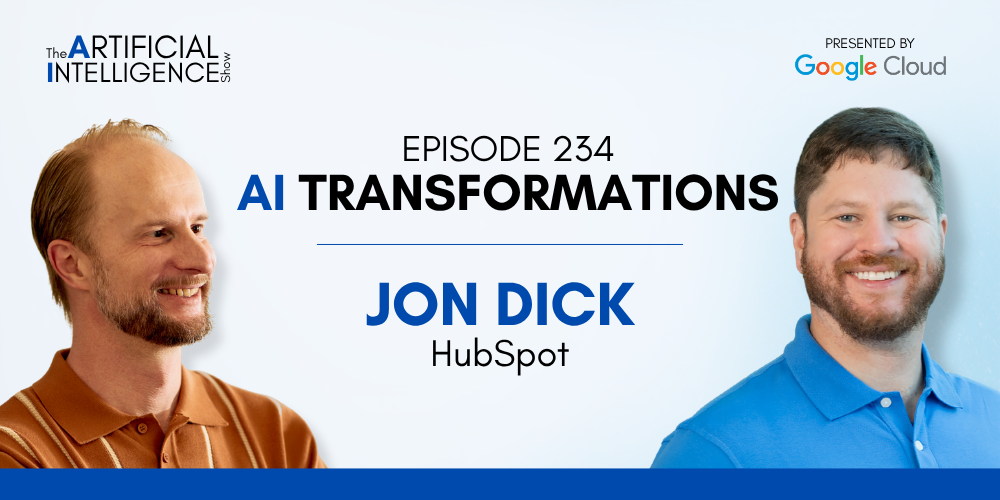
There's a difference between AI making your team faster and AI actually showing up in your numbers.
Jon Dick calls it individual productivity versus institutional productivity, and it's the idea that reorganized HubSpot's go-to-market team.
In this AI Transformations episode, Jon Dick and Mike Kaput get into how HubSpot got from hackathons and shared Slack channels to agents booking 10,000 meetings a quarter, and what got messier along the way.
Listen or watch below—and see below for show notes and the transcript.
Listen Now
Watch the Video
Timestamps
00:00:00 — Intro
00:03:36 — Meet Jon Dick
00:05:13 — What HubSpot was trying to solve, and why AI
00:08:27 — How the transformation got started and where it stands today
00:11:48 — Beyond individual use cases: demand creation and AEO
00:15:49 — What's HubSpot native, and how they pick models
00:18:36 — What had to change organizationally
00:22:10 — Why centralizing beat the pod model
00:24:39 — What got messier along the way
00:25:46 — Results across the board
00:28:35 — Why HubSpot's go-to-market context is the advantage
00:30:19 — Advice for leaders earlier in the journey
This episode is presented by Google Cloud:
Google Cloud is the new way to the cloud, providing AI, infrastructure, developer, data, security, and collaboration tools built for today and tomorrow. Google Cloud offers a powerful, fully integrated and optimized AI stack with its own planet-scale infrastructure, custom-built chips, generative AI models and development platform, as well as AI-powered applications, to help organizations transform. Customers in more than 200 countries and territories turn to Google Cloud as their trusted technology partner.
Learn more about Google Cloud here: https://cloud.google.com/
Read the Transcription
Disclaimer: This transcription was written by AI, thanks to Descript, and has not been edited for content.
[00:00:00] Jon Dick: go to market problems, haven't really changed that much over the last like century. It's basically like, how do I build demand, how do I win deals, and how do I create happy, loyal customers who retain or, spend more with me. Like, these are like age old problems. I think what's really interesting about AI is it, it creates new solutions.
[00:00:21] Mike Kaput: Welcome to AI Transformations, a special series from the Artificial Intelligence Show. I'm Mike Kaput, chief Content Officer at SmarterX and Marketing AI Institute, and I'll be your host. Every business's AI journey looks different. In each of these episodes, I sit down with leaders who have lived through real AI transformation, including the actual stories, the pain points that push them to act.
[00:00:46] The moment things started to click and the results they can point to today. So join us as we accelerate AI Literacy for All as part of our AI transformations series.
[00:01:00] Mike Kaput: Welcome everyone to episode 234 of the Artificial Intelligence Show. My name is Mike Kaput. I am the co-host of the Artificial Intelligence Show and Chief Content Officer here at SmarterX. Now, if you've been following along with this series, you might understand that today's episode is a little different than our regularly scheduled programming.
[00:01:22] This is a special episode in a limited series we're running called AI Transformations Presented. By Google Cloud, and in this series we are spotlighting how real companies are driving real change using AI. So in each of these episodes, we aim to explore how leaders at some of the world's most innovative companies are actively using AI to transform how their teams, departments, or even in some cases, their entire organization's work.
[00:01:50] We'll do that by looking at their AI transformation journeys. Figuring out what sparked those journeys, how those journeys unfolded, and even in some cases talk about [00:02:00] what results they got and what got messy along the way. And we do that by interviewing leaders firsthand right here on the show, including the leader I have the privilege of talking to today.
[00:02:11] Jon Dick from HubSpot. Much more on Jon in just a minute. One quick
[00:02:16] note here. If you are a regular podcast listener and this series is new to you, do not worry me and Paul will still be doing our regular weekly episode of the show. Paul and Cathy are still doing their AI answers episodes, nothing changes except you get even more episodes of the Artificial Intelligence Show.
[00:02:34] Thanks to this series. So with that, let's get into today's AI transformation story. Now, I wanna note before we dive in, today's episode is brought to us by Gemini Enterprise. Businesses of every shape and size are turning to ai. They're learning how to do move faster, do more, and improve their performance.
[00:02:55] But you can't just hand your data over to any platform. You need a [00:03:00] trusted partner with years of experience. That's where Gemini Enterprise comes in. Gemini Enterprise helps you build sophisticated AI agents that can connect your with your business data while also keeping it protected by world class security and government governance.
[00:03:16] That means no more compromising between performance. Protection. You can get started with Google Gem Gemini Enterprise today at cloud.google.com/gemini-enterprise That's cloud.google.com/gemini-enterprise
[00:03:36] Meet Jon Dick
[00:03:36] Mike Kaput: Okay, so today's guest, I am super excited to talk to Today's guest is Jon Dick, chief customer Officer at HubSpot.
[00:03:45] HubSpot is one of the defining companies in go-to-market software. It began as a major force in inbound marketing. It's grown into a customer platform used by hundreds of thousands of companies across marketing, sales, [00:04:00] service, and more. Jon leads HubSpot's global sales and customer success organizations, which gives him a front row seat to that full.
[00:04:08] Customer journey, including how companies create demand, build pipeline, close deals, support customers, and grow relationships over time. Now, today's transformation story is all about how HubSpot is beginning to reimagine the entire customer journey around AI agents and AI assisted workflows. We're going to talk about how AI shows up across the entire go to market motion.
[00:04:35] HubSpot, and we'll also get into the organizational side of the story because Jon is coming at this as a business leader who helps transform how the company as a whole thinks about AI and how work gets done based on what AI enables and HubSpot's organizational structures for some of its teams have changed in some big ways as a result of ai.
[00:04:57] Jon, welcome to the show. So great to have you.
[00:04:59] Jon Dick: Hey, [00:05:00] thanks for having me, Mike. How are you?
[00:05:01] Mike Kaput: I am doing great. Doing great. We were just chatting. Yeah, it's a busy week here, but there's always something new to learn. Always something new to dive into. So I wanna just get right into it
[00:05:09] Jon Dick: Let's do it.
[00:05:10] Mike Kaput: Awesome. So let's start at the beginning.
[00:05:13] What HubSpot was trying to solve, and why AI
[00:05:13] Mike Kaput: What were the kind of core problems that HubSpot was trying to solve across the customer journey, and why did you all start to turn to AI to solve them?
[00:05:23] Jon Dick: Yeah. Listen, the way I generally think about AI and I talk to our customers about ai, is that go to market problems, haven't really changed that much over the last like century.
[00:05:39] It's basically like, how do I build demand, right? How do I win deals, and how do I create. Happy, loyal customers who retain or, you know, spend more with me. Like, these are like age old problems. I think what's really interesting about AI is it creates new solutions. [00:06:00] and the things that I like, I, I started to get really excited about as like the ChatGPT moment happened.
[00:06:06] you know, the first thing was like, like there have just been these like historical constraints. In go to market for a really long time, and it was one of the first times that I felt like maybe those constraints could break. For instance, take sales reps, one of the most unmovable numbers in the last 20 years of, you know, B2B sales has been the percent of time.
[00:06:30] Sales rep spends talking to customers, and every year ambitious leaders say, we're gonna move that number up. We are gonna get to, you know, 36% instead of 35% we're doing it this year. And, it just never moves because the amount of research, the amount of admin, the amount of coordination is so high when you're trying to execute on a complex sales process.
[00:06:56] And so that's a constraint, right, Is all this work. And for the [00:07:00] first time with ai, I was like, wow. I'm like, maybe we could break that constraint. Like AI can do research, it can manage coordination, you know, it can do all of all sorts of things. So maybe we could actually start moving that number up. And it was kind of the same on the customer side.
[00:07:14] you know, when the ChatGPT moment happened, I was in our customer success org and like we have a huge problem in like customer success, which is that we wanna be able to offer really personalized, relevant, digital, help to our customers and say, Hey, you know, we can see that you're using HubSpot this way.
[00:07:35] We think you might get more value if you use it this way. But it is so hard to do that at scale in a deterministic. Marketing automation system. You of course can use personalization tokens. You can insert their name, you can insert their company. You know, you can build some like lists that are like a segment of people you have a message for.
[00:07:54] But, you know, with AI it was like, wow, maybe that constraint is broken, like maybe. We [00:08:00] could draft one of one emails
[00:08:02] For every single one of our hundreds of, you know, thousands of customers that offers them personalized advice on how to use HubSpot better. So those are the things that we got pretty excited about, was just this idea of like, we could help our more customers and we could help help more reps.
[00:08:16] Mike Kaput: That's awesome. So it sounds like from pretty much the beginning of the kind of generative AI revolution, so to speak here, you know, chatGPT coming out, HubSpot was on top of starting to think about this.
[00:08:27] How the transformation got started and where it stands today
[00:08:27] Mike Kaput: So I wonder if you could maybe walk me through some of the story. How did HubSpot's AI transformation in this area get started?
[00:08:35] How did you progress and how is AI now being used across HubSpot's customer journey today?
[00:08:41] Jon Dick: Yeah, you know, I, over the last three years, we pretty much have like systematically rebuilt how we attract, engage, and delight customers, and have really built a pretty new agentic go-to-market model, across that whole customer journey.
[00:08:55] it, you know, first of all, I would say it actually started [00:09:00] with a desire to get our employees to be AI fluent.
[00:09:03] And Every company has to figure out how to do this. I think there's a lot of advice out there about how to do it. My advice on how to do it would be, you know, a couple things. And these worked really well at HubSpot.
[00:09:14] The first was it needs to come from the top. This needs to be something that the CEO cares deeply about. Talks about everybody in leadership cares about, and talks about, and not just, you
[00:09:25] know, cares about and talks about, but actually does, like, you know, one of the more impactful things to drive AI fluency at HubSpot was very early, you know, our CEO shared a video of how she essentially used AI to do certain tasks in her day.
[00:09:40] And people were like, oh wow. Like if Yi's doing it, like I really should try it. You know? So I think that that's kinda the starting point is like, it has to be important. You know, the second thing is you gotta carve out space. you know, and I think that, you know, having actual, dedicated time to do it really matters.
[00:09:57] and a third thing is I think you have to create a [00:10:00] culture of, like no fear sharing. One of the things I've observed with ai, and I think everybody feels this a little bit, is like, everybody feels like they're, they're behind.
[00:10:09] And like somebody else has figured out something that they haven't, and it moves so fast that like, it's exhausting.
[00:10:14] Right? You're like. you know, Like, I like try and keep up with everything. And you're like, still, you're like, I'm behind on that. Oh my gosh. I'm like terrible at using ai.
[00:10:20] And so you've gotta create this culture where it's like. Totally okay for everybody to share. Like we did it through, you know, shared Slack channels and, you know, where people could post wins, examples, whatever.
[00:10:32] It really inspired people. So I think it started with just a desire that the company was gonna be AI fluent. And as the company moved to be AI fluent, it allowed us to actually, not just think about how we Operated as a team, but how we actually built the customer journey, of course the first place we started was support.
[00:10:49] You know, I think that was the first place where generative AI had super clear product market fit. we were pretty early to that. We had a lot of lessons learned in doing it. I think, you [00:11:00] know, everybody got really excited about resolution rates. and Companies still talk about resolution rates all the time.
[00:11:06] I care way more about csat, honestly, and I think that was like an early lesson is like, wow, look at the resolution rate. and meanwhile CSAT was like, woo, you know, falling off. So, you know, we've really re tilted that. And it turns out, you know, if you build great csat, your resolution also goes up.
[00:11:22] So it's kind of like, it's not like one or the other but you know, we had some lessons on that, but that's where we started. which is kind of in, in theory at the end of the customer journey, because it kind of had the best fit. Our marketing team got pretty amped about it for content creation as you would kind of expect, and, and rebuilt a bunch of workflows on that.
[00:11:39] And those are really the, and then of course coding, on our engineering team. But that, you know, that's not really, core go to market. So those are the places we started.
[00:11:48] Beyond individual use cases: demand creation and AEO
[00:11:48] Mike Kaput: Okay, cool. So it sounds like HubSpot starts by leaning into this AI fluency, AI literacy, and then from there there were some very clear use cases, workflows, what have you, [00:12:00] where AI had great product market fit, including coding, support, and then some marketing workflows.
[00:12:06] Maybe take me through what the next step was there. 'cause I know we've talked about more recently, HubSpot has started to get into AI For demand creation. AEO qualification. Could you give me a sense of kind of how that's evolved beyond these individual use cases?
[00:12:22] Jon Dick: So, you know, we pretty much just looked at the entire customer journey and we said you know, what are the constraints and how can AI break them?
[00:12:30] Jon Dick: And so it, it honestly like. You know, the number one thing I talk to our customers about right now is actually how much demand generation has changed. And you know, you, you noted that HubSpot kind of got our start by pioneering inbound marketing. It was really revolutionary for so many companies, including HubSpot.
[00:12:49] and inbound marketing has changed. So much over the last couple of years.
[00:12:54] not only has search traffic, declined a ton, but there are new [00:13:00] places that people are searching. They're searching in answer engines. And so there's a whole new type of marketing. That was kind of the first thing that we kind of did there was, we built out an AEO strategy.
[00:13:11] And we built agents to basically help us you know execute that AEO strategy so that we could,
[00:13:18] you know,
[00:13:18] show up better, get cited better, for the things that really matter to our buyers. and that was kind of the, the, the first thing on the demand gen side that we did. Another big thing though, that we did, was we did a lot of focus on like, how do we get the right tam.
[00:13:34] Added to HubSpot for our customers. you know, and, and essentially we have like a demand agent that allows us to, you know, go out, set criteria, find companies that we think would be really good fit for HubSpot, get the right intent signals for them, et cetera. so that's kind of the second thing.
[00:13:52] And then, you know, the third thing of course is you know, converting. Buyers who do show up on [00:14:00] our website and who do show interest, you know, that's kind of our, you know, A-I-S-D-R, our, our, you know, our sales bot. and, you know, the, the unsurprisingly, I think our, our sales bot has done quite well.
[00:14:14] over 80% of our website chats are handled by the bot. The results on it are very, very good. Um. Our a EO agent has grown our a EO, conversions dramatically, almost 2000%, growth over the last couple months. and we've added, I think the, the, best version of our understanding of our TAM that we've ever been able to kind of, into HubSpot to help our teams know who to focus on.
[00:14:39] Mike Kaput: I love that. So it sounds like you've actually, correct me if I'm wrong, but deploying agents to almost every. Phase of this cycle, you know, from a EO To, further demand qualification and to the actual strategy and TAM itself.
[00:14:52] Jon Dick: Yeah. And that, you know this is what I actually advise most go-to market leaders to do is just like dry out your customer journey.
[00:14:59] Mike Kaput: [00:15:00] Hmm.
[00:15:00] Jon Dick: and the steps that your team do to show up in that customer journey and move people along it, and then like literally build a strategy for each of them. And of course you have to prioritize. You can't do it all at once. unless you have a huge amount of resources. But, you know, pick the ones that are the biggest issues for you. Like if one of your top issues is like you, you know, don't have enough sales reps to, you know, get the pipeline generated that you need. You know, one, one option of course is you can go out and you can hire a lot of BDRs. Another is you can deploy a prospecting agent to actually go and do the BDR job for you, you know, and research and monitor the signals and all that.
[00:15:36] and so I, I really do like, I think the easiest thing to do is like write down on a piece of paper, Like, or describe it to, to. Or whoever, here's what my customer journey is, help me map, AI solutions against each of those. of those.
[00:15:49] What's HubSpot native, and how they pick models
[00:15:49] Mike Kaput: Nice. I love that. That's a great way to look at it. So to that point, as much as you can kind of publicly share what.
[00:15:56] Tools or agents or systems are actually [00:16:00] powering this. Like how much of this is HubSpot native? How much involves other platforms or models?
[00:16:04] Could you just kind of give us a sense of that at a high level?
[00:16:07] Jon Dick: Yeah. A lot of it's HubSpot, but a couple things I would say about, you know, HubSpot's AI versus the HubSpot go to market team.
[00:16:16] You know, one really cool thing about working at HubSpot. And probably the coolest thing about working at HubSpot is that, everybody at HubSpot loves go to market, including the, the product leaders and the engineers. Like you can have like It was like when I joined HubSpot, like the greatest thing was like sitting down with like the, you know, the postmaster to like talk about email deliverability.
[00:16:34] I was like, this is awesome. Like, I'm learning so much. and so, you know, one of the things that we often do at our, at our company is that the go-to-market team actually, innovates out in front
[00:16:45] of the product team a little bit. And actually tries to like, innovate solutions. And then, oftentimes we do them in partnership with the product team.
[00:16:53] And the product team then kind of builds them into solutions for our customers, and for some of our solutions that, that was definitely the case. [00:17:00] you know, at this point though, we are using a decent amount of the HubSpot stack for our core, you know, jobs to be done across that customer journey from a EO to, you know, finding our tam.
[00:17:12] You know, support, et cetera. our prospecting agent, all that. So, the HubSpot stack has gotten pretty good at delivering agents across those journeys.
[00:17:23] beyond that though, like we have experimented with almost everything and we like to keep a, an experimental culture, our. Team members have access to lots of tools. if anything, there's probably like a little bit of tool sprawl.
[00:17:35] that's something I hear a lot from, from our customers is kind of like, yikes. Like people are doing all sorts of stuff. I don't know. I'm not measuring it. I'm not governing it. I'm nervous about it.
[00:17:43] I don't know what's going out. big reason people actually wanna build their agent go-to market in HubSpot is for that governance and control and compliance and all that. so yeah, we use a wide range of tools. The other thing I would say though is that, HubSpot product is this way, but also HubSpot go to market teams.
[00:18:04] Like we look for the best model for the best job. and we do think that's something that HubSpot can really help.
[00:18:09] Our customers with is, you know, being sure that if you're using a HubSpot solution it's, able to, you know, orchestrate a, a across different models, you know, today to help with the best results.
[00:18:21] though, you know, in the future probably also to help with costs and, and all sorts of other things that our buyers really deeply care about.
[00:18:28] Mike Kaput: Yeah, it's a huge issue. It sounds like recently for,
[00:18:30] Many, many organizations is which models to use, how, how to regulate usage. So that's awesome to hear.
[00:18:36] Jon Dick: Yep.
[00:18:36] What had to change organizationally
[00:18:36] Mike Kaput: So a big part of Jon, where I wanted to focus this conversation with you is based on your specific expertise and background, like you're coming at this as a business leader, trying to transform how an organization. Thinks about AI and how the work gets done. And I'm curious, as you have gone from these isolated use cases to actually deploying [00:19:00] AGI agentic AI across many phases, if not all the phases of the customer journey, what has had to change organizationally inside go to market team inside HubSpot as a whole, as this transformation has progressed?
[00:19:13] Jon Dick: Yeah. Well, I mean, I think the way that we build AI solutions has changed for our go-to-market team. That's probably the biggest place we've seen change.
[00:19:21] Mike Kaput: Okay.
[00:19:22] Jon Dick: You know, when we started it was, um. Wild West, everybody, here's some tools, have a go share what you've built into Slack channel. We hosted tons of hackathons, like it was, I mean, it was awesome.
[00:19:34] It was like really fun. It like unlocked so much creativity and ingenuity and and whatnot. you know, but we pretty quickly realized that if we were gonna make like. You know, something we think a lot about is the, the framework of moving from like individual productivity to institutional productivity.
[00:19:49] and really like obsessing about this idea that, you know, AI of course can help with individual productivity, but like the real unlock for businesses is if you can get institutional [00:20:00] productivity you can meaningfully move, you know, items in your,
[00:20:03] your your PNL or, growth results or whatever.
[00:20:06] and so we pretty quickly realized that if we wanted to get to institutional productivity, we needed a different way to build. and it's. Taken several evolutions. The first evolution was that, we built a bunch of pods. So we took, you know, people from different teams, including subject matter experts and engineers and data people and whatever.
[00:20:23] And we, we Cobble them together into some pods and we put all of them under one, leader, who is kind of an AI pilled, you know, marketing growth leader, Kieran Flanagan, and. That was awesome. We did that for about a year and we got really great progress. we moved all the KPIs we were working on, and it was great, you know.
[00:20:46] But we realized that we could probably go further and go faster if we went, even further. And the pod model was great, but in the pod model there were still competing priorities and it was a lot of coordination cost and and whatnot. And so we actually [00:21:00] made a pretty big change to how we operate.
[00:21:01] About three months ago, and we had all of our, essentially engineers. Systems people, data people, product people, SMEs that work on go-to market, agentic work.
[00:21:21] All actually, you know, direct line in now to, to Keiran Flanagan. That was a big, it was a big change for us. and so, he really now is able to, execute at a higher pace. And, I always get questions about like, oh, like. You know, don't, aren't you nervous? And I'm like, well, no, because I'm like super aligned with him and like we have the same KPIs.
[00:21:46] So, as long as we're all running together, but I think sometimes people get nervous about like. Losing control. And I think what I would argue is that in ai, the pace that you can and should move it is [00:22:00] worth finding someone who can really lead that, and, and letting them run with it.
[00:22:04] Because I think you'll just get better, results in a meaningful way. and Kieran's doing an awesome job. He's great.
[00:22:10] Why centralizing beat the pod model
[00:22:10] Mike Kaput: yeah, I'd love to explore that a little further. It sounds like that this centralization or unification of these teams, under one leader in one function, it's the benefit there is just the ability to move and react faster.
[00:22:25] Like, how has that played out and how is that materially different than the pods model or even just kind of the wild, wild west model?
[00:22:33] Jon Dick: Yeah, I mean, I think it's about the ability to commit to bigger, Bolder goals. More than anything and when you're running a pod model, you're like, I think I can do my best here, but like, I don't actually like, these resources aren't.
[00:22:48] On my team and like, you know, in some cases it's like competing priority. It just cleans everything up. and it also just allows for a lot more fluency. Like, I think we're just learning like the skills that are needed continue to evolve and [00:23:00] change. You know, just like it was like prompt
[00:23:02] engineers to, you know, go to market engineers, to like engineer engineers to, you know, and so like to data scientists, you know, MLEs like that, that whole world.
[00:23:12] And I think having all of those people on the same team allows for a lot more fluency in that stuff. We also think it's great for talent acquisition and retention, which is that, you know, those people feel like they are, are part of an organization where they're working with some of the best people in the world on these problems.
[00:23:29] I think this is how the best teams built marketing for a while, but, you know, we used to have this big debate about like, um. How we organized our SEO teams at HubSpot. SEO is huge HubSpot. we work in many different languages. You've got regional marketing teams, of course, and should the regional marketing teams own the SEO strategy for their region or should the central team, and how do you make that decision?
[00:23:55] And one of the core ways that we made that decision was that, you looked at [00:24:00] whether the domain expertise in like, the topic area. Really, really mattered. And for something like SEO, it just does, right? Like If you were world-class SEO, you got a legitimate edge over, you know, the, the rest of the world.
[00:24:15] And number two, whether or not, having that team be centralized, would result in hiring. hiring. You know, people who cared more about the craft, than than others. And I think those are the benefits you get out of that. And, you know, model is we feel like we can, you know, hire and retain really, really great, awesome people that, wanna be the best in the world at this stuff.
[00:24:39] What got messier along the way
[00:24:39] Mike Kaput: Yeah. That's awesome. I'm curious, as you're going through this evolution, it sounds like pretty recent, last three months, kind of centralizing these folks, folks, under a single team or function, what has been in your experience, a little messier or more confusing or harder than usual as we go through these kind of growing pains?
[00:24:59] Jon Dick: I mean, the [00:25:00] hardest thing about it is always trade-offs.
[00:25:01] Mike Kaput: Mm.
[00:25:02] Jon Dick: And it's about local priorities versus global priorities or, I think one thing that the centralized team, Really ensures that the global priorities are the priorities. Which I think is actually a very good thing, because focus matters.
[00:25:23] and you know, we know that in AI in particular, if you do a lot of stuff mediocre, you get pretty mediocre results. And if you do get really focused and execute really well, but there's all sorts of pockets then where you're like, oh, I wish I could kind of like, play around over here. And, and it makes it a little harder to do that stuff.
[00:25:39] So, but I think the net on that is, you know, much more positive than negative.
[00:25:46] Results across the board
[00:25:46] Mike Kaput: That's awesome. So it sounds like at every stage of this journey, both from kind of the individual exploration to the pods model to the more centralized model, it sounds like you've been getting increasingly effective results across kind of go [00:26:00] to market, across the customer journey.
[00:26:01] I'm curious, you know, you shared some numbers, some impacts, any other results that are coming out of, or that you're starting to see in the early phases of this more unified model?
[00:26:11] Jon Dick: Yeah. Well, I shared the, the data on the marketing side. I didn't really go into the engage or the delight side.
[00:26:22] But, on the engage side, I mean, the biggest thing we've seen is we've seen win rate go up with ai, basically we have An AI assistant called Guided Success. Which is built in HubSpot's Breeze assistant. so we have an assistant in, in HubSpot, and it's, there's an Outta the Box assistant, but there's also custom assistance.
[00:26:42] It's a custom assistant that, we built and tuned really for the job of the sales rep it relies on a whole bunch of things. all the context on how to win deals at HubSpot, and, when reps use that, the win rate is up a bunch. similar with prospecting. We've seen,a lot of reps wanna build their own, like prospecting agent.
[00:27:03] And they'll, they'll build a gem for it, or, you know, AGI clean agent or whatever. and because, you know, they kind of like, number one, it's fun. it's fun to build. Everybody wants to build, and Number two, they're like, I think I've got a good way to do it and I want to, you know, try my way. And I think what we have pretty consistently seen is that the, the stuff that has been.
[00:27:22] Globally built and really tuned with the right context and the right, you know, evals and everything, just really outperforms the stuff that individual reps build. And we see that. So we see that with our prospecting agent and everything. you know, and our prospecting agent basically.
[00:27:41] like, I think the number we had, from last quarter was like, booked 10,000 meetings. So Yeah. Real scale.
[00:27:49] Mike Kaput: No kidding.
[00:27:50] Jon Dick: Yep. And on the support side, as I said, you know, we're industry standard resolution rates, you know, 60% CSAT is high, now on that experience, [00:28:00] after, a couple months of chipping away at it and we see that our CS reps also have an assistant,
[00:28:08] that is able to trigger a bunch of agents for the work that they do. you know, the challenge of course with any CSM team is like, how do you, how do you spend as much of your time with customers because It's just, you know, I'm supposed to get a lot of customers.
[00:28:23] and so we see when our, when our CSMs use the CS assistant, save rates go up. We've got a seven point increase in save rates, better usage, you know, all the metrics that you'd wanna see.
[00:28:35] Why HubSpot's go-to-market context is the advantage
[00:28:35] Mike Kaput: Yeah. awesome. And you mentioned something so interesting there, which I've heard others echo, which is HubSpot's context at that global level is what seems to be able to help get much better results out of just the technology versus someone building on their own.
[00:28:51] So it really, I mean, HubSpot is such an advantage there, it sounds like. I mean, just because you've had so much time in the market, you have learned what works and what doesn't the hard [00:29:00] way, and now you're able to train agents to then help new people learn that quite quickly. It sounds like.
[00:29:04] Jon Dick: Yeah.
[00:29:05] I mean, we think so, and we've seen the data on it, and so we've seen our internal data, but also, you know, data from our customers using our agents.
[00:29:13] HubSpot has a ton of context, and that context comes in a whole bunch of forms.
[00:29:21] There's just like, you know, the context that, every customer has because their own data and workflows are, are already built out. Which of course, like, you know, I've never seen so many customers kick off data cleanup projects is as, you know, 2026, everyone is like, okay, now's the time.
[00:29:39] But, that's obviously a big part of it. But to your point, we also just, Eval our agents that we build for our customers, on, you know, standard metrics, but on go to market outcomes specifically. and those agents have access to the context on go to market, like,
[00:29:59] Mike Kaput: [00:30:00] yeah.
[00:30:00] Jon Dick: We like to think that like the reason you would wanna talk to somebody at HubSpot is because we know a lot about go to market and we spend our lives thinking about and developing solutions for go to market, and we really hope that our agents are the same way, that they have an advantage because they know a lot about go to market and, have seen a lot of go to market and practice.
[00:30:19] Advice for leaders earlier in the journey
[00:30:19] Mike Kaput: So Jon, honestly, I could talk about this for hours here, but as we wrap up this conversation, hopefully the first of many, it's been really cool to hear these real details of how this transformation journey has gone at HubSpot. I'm curious for someone in your type of role listening who is a little earlier in their AI transformation, what is the best advice you could give them based on some of the things you've learned the hard way?
[00:30:48] Jon Dick: Okay.
[00:30:48] My top advice right now, would be the following. number one is you are not behind. Everybody thinks they're behind. You're not behind. everyone is [00:31:00] trying to figure this out still, including companies like, like HubSpot. We are all out testing, learning. We learn every single hour of every single day what is working, what's not.
[00:31:08] And so hop on in, the water's warm, the, second thing that I would advise people, you know, who are newer to this, is, you know, pick something to focus on. Pick a real problem for your, your business and focus on trying to solve that problem versus doing everything at once.
[00:31:30] and you know, the third thing that I, I would probably say is just set a really high bar for quality.
[00:31:36] you know, I think. HubSpot, like, I hate slop. It is like,
[00:31:40] it's so terrible. Like, and you see it everywhere? You know? And it's like, we really deeply believe at HubSpot that like the power of AI is not just AI doing everything on its own. It's like, you know, human authenticity plus AI efficiency is like the secret sauce.
[00:31:56] And you know, so set a high bar, have your people. [00:32:00] Be part of it, not separate from it. and you know, if you wanna get started and go to market AI and you're a HubSpot customer, like get started with HubSpot ai, it's got context that will help you get out to, a faster start and higher quality outcomes.
[00:32:15] you know, I think sooner, than you would if you kind of built everything from scratch in your own.
[00:32:19] Mike Kaput: Well, Jon, thank you so much for sharing today. This is an incredible transformation story. We're going to absolutely be following along closely. It sounds like HubSpot's doing incredible things, and this is just one of the many AI transformation stories we're hoping to share with you all through this series.
[00:32:36] So we appreciate everyone listening in. Jon, thank you so much for being here. Really appreciate it.
[00:32:41] Jon Dick: Yeah, thanks Mike. Good to talk to y'all.
[00:32:43] Mike Kaput: Thanks for listening to our AI transformation series from the Artificial Intelligence Show. To keep learning, visit SmarterX.ai where you'll find on-demand courses, upcoming classes, and practical resources to guide your AI journey. [00:33:00] Until next time, stay curious and explore ai.
Claire Prudhomme
Claire Prudhomme is the Marketing Manager of Media and Content at the Marketing AI Institute. With a background in content marketing, video production and a deep interest in AI public policy, Claire brings a broad skill set to her role. Claire combines her skills, passion for storytelling, and dedication to lifelong learning to drive the Marketing AI Institute's mission forward.