
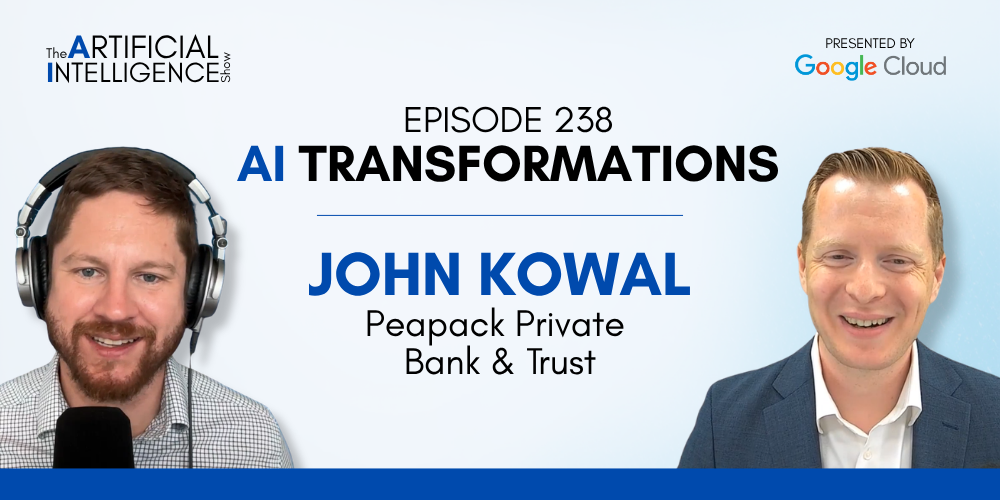
A 700-person bank isn't supposed to build its own software. For decades, Peapack Private Bank and Trust did what banks its size always do: buy, don't build. Then it looked at a $375,000-a-year vendor contract, said no, and had its own engineers build the tool instead.
In this week's AI Transformation series, Mike Kaput sits down with Peapack Private CTO John Kowal to trace an AI transformation that started in 2023 with basic chat and has grown into a team of named "digital employees" — Alex, Bruce, Penny — that answer support tickets, review the bank's websites, and message staff in Teams. They get into why every AI agent gets a name and a personality, how 29 AI champions identify use cases from inside the business, and the one guardrail Kowal says every regulated company needs.
Listen or watch below—and see below for show notes and the transcript.
Listen Now
Watch the Video
Timestamps
00:00:00 — Intro
00:06:02— What Peapack Private Bank and Trust does
00:07:41 — How the AI transformation started
00:10:24 — What's driving Peapack from chat to agents
00:12:09 — Concrete examples of AI changing daily work
00:16:23 — Re-engineering workflows, not just layering on tech
00:17:25 — The technology stack powering the work
00:19:24 — The data warehouse foundation and OpenAI + Microsoft ecosystem
00:24:14 — How AI champions surface use cases
00:25:30 — Measuring impact and ROI
00:27:39 — Lessons learned and what comes next
00:32:09 — Why Peapack gives its digital employees names
00:34:18 — How the CTO role and tech team are changing
00:35:59 — Competing with larger banks
This episode is presented by Google Cloud:
Google Cloud is the new way to the cloud, providing AI, infrastructure, developer, data, security, and collaboration tools built for today and tomorrow. Google Cloud offers a powerful, fully integrated and optimized AI stack with its own planet-scale infrastructure, custom-built chips, generative AI models and development platform, as well as AI-powered applications, to help organizations transform. Customers in more than 200 countries and territories turn to Google Cloud as their trusted technology partner.
Learn more about Google Cloud here: https://cloud.google.com/
Read the Transcription
Disclaimer: This transcription was written by AI, thanks to Descript, and has not been edited for content.
[00:00:00] John Kowal: And if we want AI to be a true extension of our teams, like we had hoped, we need to change how we interacted with ai. and that's how we came to embrace this concept of, of digital employees.
[00:00:09] Mike Kaput: Welcome to AI Transformations, a special series from the artificial intelligence show. I'm Mike Kaput, chief Content Officer at SmarterX and Marketing AI Institute, and I'll be your host.
[00:00:21] Every business's AI journey looks different. In each of these episodes, I sit down with leaders who have lived through real AI transformation, including the actual stories, the pain points that push them to act. The moment things started to click and the results they can point to today. So join us as we accelerate AI Literacy for All as part of our AI transformations series.
[00:00:48] Welcome everyone to episode 2 38 of the Artificial Intelligence Show. I am Mike Kaput, co-host of the Artificial Intelligence Show and Chief Content Officer here at SmarterX. [00:01:00] Once again, today's episode is a little different than our regularly scheduled programming. This is a special episode in a limited series we're running called AI Transformations presented by our friends at Google Cloud.
[00:01:14] So in this series, we are spotlighting how real companies are driving real change using ai. So in each of these episodes. We're going to explore how leaders at some of the world's most innovative companies are actively using AI to transform how their teams, departments, or even entire organizations work.
[00:01:33] We're going to look at what spark transformation, what work looked like before ai, how journeys unfolded, what got messy along the way, and what results AI is starting to unlock for businesses. And the way we do this is we interview leaders firsthand. Right here on the show, including John Kowal from Peapack Private Bank and Trust who is here with me today.
[00:01:56] Much more on John and his work in a minute. Now, [00:02:00] just kind of to reiterate, the reason we're doing this series in partnership with our friends at Google Cloud is simple because AI transformation often you hear a lot of talk about it, but it can still feel abstract. Despite the hype, despite everyone seeming to talk about it and use it as a buzzword, far fewer people are actually showing what this looks like in practice inside real companies with real teams, real constraints, and showing real business outcomes.
[00:02:28] So the entire goal here is to make AI transformation much more concrete. We want you to hear how other leaders are approaching it. What they're learning, what they would do differently, and what practical lessons you can apply as you think about AI inside your own organization. So one final note here. If you're a regular podcast listener, don't worry.
[00:02:49] Me and Paul are still doing our thing on the regular weekly episode of the show. Paul and Kathy are still doing their periodic AI answers episodes, so nothing changes here except you get more [00:03:00] episodes of the Artificial Intelligence show. Thanks to this series and thanks to Google Cloud sponsorship. So with that, let's get into today's episode.
[00:03:10] Today's episode is brought to you by Gemini Enterprise. Businesses of every shape and size are turning to ai. They're learning how to move faster, do more, and improve their performance. But you cannot just hand your data over to any platform. You need a trusted partner with years of experience. That's where Gemini Enterprise comes in.
[00:03:31] Gemini Enterprise helps you build sophisticated AI agents that can connect with your business data while also keeping it protected by world class security and governance. So no more compromising between performance and protection. So if you wanna learn more and get started today, go to cloud.google.com/gemini-enterprise.
[00:03:54] That's cloud.google.com/gemini. Dash Enterprise. [00:04:00] All right, so I'm super excited for today. We are talking with John Kowal, chief Technology Officer at Peapack Private Bank and Trust. Peapack Private is a boutique private bank with about 700 employees and $8 billion in assets. They serve successful individuals.
[00:04:16] Families, business owners, family offices, and their trusted advisors through personalized relationships and bespoke banking, lending, wealth management, investment banking and trust solutions in the greater tri-state area. Now, John is here. Because Peapack Private has been building an AI transformation since 2023, and the story shows just how far an organization can progress when it treats AI as far more than just a chat tool.
[00:04:45] So the journey that they undertook and we're going to discuss began with AI use cases like research, writing, meeting summaries, and employee assistance. It has since expanded into data analysis, custom applications. Automated [00:05:00] workflows, AI agents, and what Peapack private calls digital employees. Now, along the way.
[00:05:07] The bank actually created a network of AI champions across its business divisions and changed how it thinks about developing software. In one example, we'll talk about Peapack Private considered buying a vendor solution that would've cost more than $300,000. And instead built its own because AI changed what they were able to build internally.
[00:05:29] Now the bank is building and deploying digital employees that combine ai, traditional automation, internal data, and employee facing tools to perform. Recurring work proactively. So in this conversation, we are going to unpack all of this, how the transformation evolved, how Peapack private finds and develops use cases, what technology powers the work, what results they're seeing, and what John and his team have learned along the way.
[00:05:54] So John, welcome to this show. Let's get right into it here. Really appreciate you having you.
[00:05:59] John Kowal: And [00:06:00] thanks for having me, Mike. thrilled to be on the show.
[00:06:02] What Peapack Private Bank and Trust d
oes
[00:06:02] Mike Kaput: So before we dive into this, maybe just give our listeners a quick picture of Peapack Private Bank and Trust in case they're not familiar with what a boutique private bank does.
[00:06:15] John Kowal: So Peapack Private was founded back in 1921 and we started as a small New Jersey community bank. But about 14 years ago, Doug Kennedy, our CEO, came on board and really transformed the bank. So we went from that traditional community bank into the boutique private bank we are today. Right? So, as you mentioned, we've grown to over 700 employees, $8 billion in assets.
[00:06:36] we also have a wealth division that manages $13 billion in assets, and we've expanded throughout the New York Tri-State area now, so. We're offering services like banking, lending, wealth management investments. So we have the capabilities of a much larger financial institution, but we still deliver a very personal banking experience, right?
[00:06:56] So specifically, every single one of our clients has [00:07:00] a single point of contact who they can call, who knows them, who understands their financial relationship. You know, I think that's what we mean when we say, you know, we're a boutique private bank. Um. and regarding myself, you know, I've been in technology leadership here at the bank for 11 years.
[00:07:14] So prior to joining the bank I was in banking industry consulting. So banking technology has been really my entire career. And I oversee what you'd call traditional technology, right? Technology support, infrastructure training. And I also see our, oversee our technology innovation groups. that's where we have a data engineering team and our AI engineering team.
[00:07:33] And those are certainly two teams that. Did not exist, when I started here 11 years ago.
[00:07:39] Mike Kaput: Let's kind of start at the beginning here.
[00:07:41] How the AI transformation started
[00:07:41] Mike Kaput: So. You've got a really interesting AI transformation that has happened across the bank over the last few years. How did that get started? What kicked it off? Kind of walk us through maybe the steps of where it went after kickoff.
[00:07:54] John Kowal: Yeah. We, we started back in 2023, which gave us a bit of an early start. So this was back when [00:08:00] Microsoft copilot was, still called Bing Chat for Enterprise. So it seems like, seems like forever ago. but generative AI was obviously new and we looked at Sid. There's a, there's just a ton. Tremendous potential here, right?
[00:08:12] So we said, well, we need to sit down and learn as an organization. So we put the appropriate policies and governance around it. We did some extensive employee training and by the end of 2023, every employee at the bank had access to AI chat and AI meeting summary technology and that, that was sort of just the beginning for us.
[00:08:30] from there we started building that network of 29 AI champions across the bank. So. These are people embedded within the different lines of business, who understand the department and they're identifying the real problems we're solving and that transition AI from being. Technology driven to business driven.
[00:08:49] So instead of technology introducing tools and ideas to the bank, the people who are actually doing the work are now building the pipeline of use cases and that's when the business lines got involved. That's when things I [00:09:00] think really began to accelerate for us. So it was at that time. We realized that the future of AI wasn't gonna be chatting with a bot and asking it to do things.
[00:09:11] That's not how we work. That's not how people work. and if we want AI to be a true extension of our teams, like we had hoped, we need to change how we interacted with ai. And that's how we came to embrace this concept of, of digital employees. Right. And as you mentioned, these are AI agents that are working proactively and they sit on top of.
[00:09:30] Other AI agents, automations, data, even some of our more classic tools, and they communicate with us through normal channels, like teams chat, if there's something urgent, or Outlook, email. If it has, you know, something routine and it wants to communicate, and you can reply to those messages too and have a conversation, that's where the AI agent comes in as well.
[00:09:49] So that's really where we're at today. We've, we've started to evolve from it as this individual productivity tool more towards AI as an extension of our teams. And now our goal is [00:10:00] let's scale this across the bank.
[00:10:02] Mike Kaput: We're gonna dive into each of those parts here because you've followed a really interesting progression, I think is kind of almost where the industry has gone as well from this individual experimentation with chat to actually working hand in hand with digital employees or agents.
[00:10:16] But I'm curious that through line here. Sounds like you've been pretty early to these really important structural trends in ai.
[00:10:24] What's driving Peapack from chat to agents
[00:10:24] Mike Kaput: Whether it's recognizing early on that generative AI was going to be a thing, whether it's recognizing that, okay, we're moving from chat to agents. could you maybe just tell us a little more about what's driving that?
[00:10:36] Is that you and your team being ahead of these trends? Is this leadership? How is all of that innovation and staying ahead of the curve, being driven and in the organization?
[00:10:48] John Kowal: Well, you mentioned leadership and I think leadership buy-in and support is, is critical here. Our, CEO, Doug Kennedy has been supportive of these initiatives from day one.
[00:10:57] in fact, the AI champion concept was actually his [00:11:00] idea.
[00:11:00] Mike Kaput: Mm-hmm.
[00:11:01] John Kowal: so that's really, I think, how you drive. Adoption with, with leadership buy-in and also being willing to fail. Right? You, you are gonna fail. you're going to work with technologies and experiment with use cases that aren't gonna work out.
[00:11:16] and that's, that's important. But that's, that's a hard culture to drive. Especially when, you know, we are in a larger company managing projects and they have start dates and they have finished dates and they report up to the board and you know, they have little, they're green. If they're going well, they're yellow if they're at risk and they're red if they're failing.
[00:11:32] You need to get into that culture of it's okay to fail, it's okay to work with these new technologies because you will start to fall behind. You know, we, we could talk about prerequisites right, too. So we built our data W Warehouse about five years ago.
[00:11:44] Mike Kaput: Mm-hmm.
[00:11:45] John Kowal: And if we didn't have that, we wouldn't have been able to start building some of our AI tools on top of that data.
[00:11:50] And these things take time. So you can't build a data warehouse. At the same time you're building agentic ai. At the same time, you're bringing on development capability within your teams. These [00:12:00] things all need to happen literally and be built up over time.
[00:12:04] Mike Kaput: So we will dive a little deeper into each aspect of this AI transformation.
[00:12:09] Concrete examples of AI changing daily work
[00:12:09] Mike Kaput: But before we get to that, I'm just curious, maybe if you could give us a snapshot today of some concrete examples of how AI is now changing the way work actually gets done inside the bank due to some of the initiatives you've mentioned.
[00:12:22] John Kowal: Yeah. So one, one interesting thing we saw is that this was the first year that the number of third party technologies our bank used actually decreased from the prior year.
[00:12:31] Mike Kaput: Mm-hmm.
[00:12:32] John Kowal: So our AI engineering team has, has kind of started to reverse that build versus buy equation, especially for a company our size. I think historically, 700 person bank, it was always gonna be buy, not build. We simply didn't have the development resources to, to build those customized solutions for every business need.
[00:12:50] And, AI development is, is really changing that dynamic for us now. Now, don't get me wrong, we have a lot of. Great off the shelf products. but the inability for a [00:13:00] company like us to build something that precisely fits our needs or precisely fits our client needs, that was starting to become a real disadvantage for us compared to our much larger peers in, in today's kind of tech driven world.
[00:13:11] Right? So, so the game has changed, and I'd say one example is our account review process and our wealth business. this is a process that was being managed in spreadsheets and it wasn't gonna scale. Right. So, so we looked at third party solutions that would've cost us, you know, as you mentioned, $375,000 plus a year.
[00:13:29] Mike Kaput: Yeah.
[00:13:30] John Kowal: And that's a significant investment, to replace something that, you know, frankly was working reasonably well in spreadsheets. but fast forward to the, you know, dawn of this AI era, and our AI engineers used Codex to build a mini platform that organizes the reviews and approvals and pulls in data from our data warehouse.
[00:13:49] Again, those prerequisites are there. And yeah, each review is taking 50% less time than before. And at the same, so it's a software product that works at the same time. We're saving hundreds of thousands of [00:14:00] dollars. and that's how we get our employees, you know, back to their clients and away from their computers, right?
[00:14:05] Mm-hmm. By doing these kind of automations, I'll give you some interesting, specifics about our, our digital employees and the impact that they've had too. so we've had. We have a digital employee in it named Alex, that actually monitors all of our, ServiceNow tickets, our support queue, right, and it's replying to each one with an immediate suggestion.
[00:14:23] It's routing tickets to the appropriate subject matter experts. It's also continuously monitoring those ticket queues to see if there's any escalation needed. So we only launched Alex actually a few weeks ago.
[00:14:35] Mike Kaput: Mm-hmm.
[00:14:35] John Kowal: So it's still learning, but it's already operating, at a rate of, it's closing roughly half the tickets of a full-time employee.
[00:14:43] which is, which is a great start. Even our marketing team's digital employee does a weekly review of all of our websites, and it's looking for outdated links and dead, you know, outdated content. it's also providing A-E-O-S-E-O-G-E-O suggestions so people can better find [00:15:00] us. and there are products out there that do this type of website scanning, but, you know, we also just took a few minutes programmed a agent and we're getting these phenomenal results.
[00:15:08] So, you, you'll like this there. digital employees named mia, which is a acronym for marketing Intelligence agent. So very creative, no surprise, creativity from our marketing department.
[00:15:17] Mike Kaput: Sure.
[00:15:18] John Kowal: but. You know, these are, these are the projects that we're working on day to day. I'll, I'll share with you one last example, much larger in scale.
[00:15:26] we partnered with an AI company, Verapath, and we wanted to take the work that our AI engineering team was doing and augment it with really a, a more skilled company that can tackle some really big use cases and set aside that time. So, today we're actually launching a redesign, loan closing process.
[00:15:42] And, you know, would you believe, uh. Loan closing is about 55 different steps. You know these, so these processes are big. You, you, sometimes you wouldn't even think it, but the change management we know in organizations is never easy and here's why. These pros projects are kind of a multi-step process, right?[00:16:00]
[00:16:00] What's the process today? What do we want the process to be tomorrow? How can we use AI and automation to improve that future state process? And then we actually have to implement the new process. So these are tough projects, you know, the high rate of failure traditionally in the industry. but with AI and working with qualified companies, you know, we can start tackling those really big use cases.
[00:16:23] Re-engineering workflows, not just layering on tech
[00:16:23] Mike Kaput: So we'll talk maybe a little bit more about this later in the episode, but it sounds like it's not just trying to apply technology to existing workflows, though that's very important. It's actually re-imagining and re-engineering how some of this work works. Is that right?
[00:16:39] John Kowal: Yeah. You know, we're fortunate to be a growing company and you know, we're at the point now where, you know, we have these kind, this kind of community bank processes that don't quite fit into the private bank that we are and that we want to be.
[00:16:50] So we had to go through this business process transformation anyway. AI kind of came at the right time where we can say, let's transform this business process. Also, let's automate [00:17:00] it.
[00:17:00] Mike Kaput: Mm-hmm.
[00:17:00] John Kowal: so it just, the stars align for us, pretty nicely. and now we're able to focus on revisiting these processes throughout the bank.
[00:17:09] this is the biggest business transformation process, that this bank has ever undertaken. And AI is fueling it and allowing us to do some really incredible things that are gonna make us, and are already making us a very competitive bank, even against peers that are. 10, 20 exercise.
[00:17:25] The technology stack powering the work
[00:17:25] Mike Kaput: Wow. So let's open the hood a bit on the technology being used here.
[00:17:30] You had mentioned Codex briefly. It sounds like there's agents obviously in the works, maybe using existing systems. Can you give us a sense, as much as you can share about what AI models, tools, or platforms are powering this? Like how, give us a sense of how that fits together.
[00:17:46] John Kowal: Yeah, so we, we made a decision early on to, uh.
[00:17:49] Standard is primarily on openAI's technology. Okay. So ChatGPT Enterprise for our employees, codex for Development teams. we use a lot of their enterprise APIs for all those agents we've built. [00:18:00] But as I mentioned, there's also a lot of non-AI technologies. our enterprise data warehouse that, that we built now, we took AI and placed it on top of that.
[00:18:09] It's a, it's a product we call Project Atlas and it has our entire data warehouse schema along with the knowledge base of how our organization actually operates.
[00:18:18] Mike Kaput: Hmm.
[00:18:18] John Kowal: So it kind of turns questions into query code that can be run against the data warehouse. And it's used by our data analyst and it's really started to significantly change how quickly we can get answers and how quickly we can deliver on reporting.
[00:18:32] You know, we're sitting in meetings actually able to return answers to questions that that our executives have, which is, which is a really neat thing. And even amongst that small group of data analysts, there were over, I think, 2000 transactions. With Atlas, between, you know, the analysts actually communicating with it in the past month alone.
[00:18:51] So it shows, you know, how valuable these tools have become. I'll share with you too, on the hardware side, our, our digital employees actually have their own computers. Oh, wow. And [00:19:00] your listeners probably won't be surprised that they're, they're Mac Minis, which of course have become very popular in.
[00:19:05] AI community, we didn't cause a shortage, but we, it,
[00:19:08] Mike Kaput: I I was gonna say this is your fault. Yeah.
[00:19:11] John Kowal: but, you know, they, they give our digital employees, where necessary their own computing environments so they can run tools and interact with us. so it really creates a, a very physical presence, that digital employee, technology.
[00:19:24] The data warehouse foundation and OpenAI + Microsoft ecosystem
[00:19:24] Mike Kaput: Excellent. So it sounds like that data warehouse layer that you started kind of very presciently, you know, five years ago, is really key to this. But then on top of that, you've got openAI's technology basically powering this and integrating it sounds like with existing tools, like things like that you're using to chat, things like that.
[00:19:41] Is that like Microsoft Teams outlook kind of that thing or that type of, ecosystem?
[00:19:46] John Kowal: Right. We want them to work how we work. So they are using Microsoft teams. You know, you don't have to go into a chat bot. To, to find these AI agents. Hmm. and remember they're reaching out proactively. So if, if there's something urgent, like they look at a report, they find a concern, they're gonna [00:20:00] send a message over teams instead of an email that you might not see till later.
[00:20:04] and you want, you wanna build a fine balance there. but that's, that's how we use those tools, just like a, like an employee would. and you are right, you know, there's a lot of AI in what these digital employees are using. but there's also some deterministic workflows. You know, we wanna use AI where.
[00:20:19] AI is good where it makes sense, you know, summarizing things, doing research, analyzing documents. but if we're gonna essentially run what's the equivalent of a Python script, the digital employee can call that and just have that run instead, you know, we don't need to overuse ai, just to, just to, you know, make it seem like digital employees are fully ai, they're using the tools that make sense for the tasks that they've been assigned.
[00:20:42] Mike Kaput: So just to be clear, if I'm working at Peapack Private in certain teams, at least today and in the future, I might be getting teams messages from digital employees that are proactively alerting me of different things that might be relevant to my work.
[00:20:57] John Kowal: Absolutely. You, you would be, you know, [00:21:00] that's today.
[00:21:00] And yeah, as we grow this program that really will be every employee in the future, it's, you know, we're the size bank where everyone in the role has multiple responsibilities and we wanna get everyone back to the things that they're skilled at, you know, the things that they have a background in and get rid of the monotonous work.
[00:21:17] And that's really where these digital employees are coming in. and it's, it's really changing, you know, our. Culture, we're spending more time with clients, and we're able to kind of refocus our efforts on the things that we're good at.
[00:21:29] Mike Kaput: I love that. and that kinda leads to another question I have because, you know, whether it's digital employees or, you know, undergoing this type of transformation, as AI becomes such an integral part of the bank, how are you organizing people and responsibilities so that this transformation spreads just beyond it or tech savvy people?
[00:21:51] I know you mentioned the 29 AI Champions. I'd love to hear a little more about that. How is AI being diffused across the organization?
[00:21:59] John Kowal: Yeah, we're actually [00:22:00] celebrating, one year of our AI champions program. so they've, they've since completed around a hundred projects at the bank. and they, they have a pipeline of about 80 plus more.
[00:22:10] It's a growing pipeline, so you can see that they're bringing some great ideas to us, and it's not a management committee. we have, we have enough of those, you know, it's, we look for people that are embracing technology, that have a, a, you know, keen interest in new technology that, that are interested in ai.
[00:22:26] And every division has these people. you just have to find them and it actually ended up becoming a competitive. Committee. People wanted to join, they wanted to make AI a part of their careers even early on. And I'm a real firm believer that every organization has these individuals. you just have to find them and they will help you embrace the technology.
[00:22:47] And now Mike, you mentioned management buy-in, right? That's absolutely key here as well. I mentioned our CEO has, has really been a champion of the AI champions program and his ongoing support has been absolutely critical. But, you [00:23:00] know, really make no mistake you won't have AI transformation without cultural transformation.
[00:23:05] Right. This is a big shift and, training has been a big part of this as well too. we have what we call our tech innovation webinar, and it's a, a quarterly, series we run out of the studio in our headquarters, which is actually, where I am right now. And, we bring on actually several of the AI champions onto that.
[00:23:23] webinar and they share their success stories. So it's not just technology telling people about it. and it always gets people thinking, you know, in some ways they're just genuinely inspired to hear, what other departments are doing with ai. but in other ways they, they look at a process and they say, Hey, wow, our department could use that too, and kind of spreads the word about what's possible.
[00:23:42] Mm-hmm. So I, you know, overall. It's just really important to keep pace and keep learning with this technology. and when we do meet monthly with the AI champions and we actually meet individually with each one to talk about their initiatives, talk about their specific pro projects. You know, there's, there's [00:24:00] hundreds of meetings happening about AI throughout our bank, but without that, you, you start falling behind.
[00:24:05] You start losing focus. that's how important. This technology is to us.
[00:24:10] Mike Kaput: And just to make sure I really understand kind of how the nuts and bolts of this are working.
[00:24:14] How AI champions surface use cases
[00:24:14] Mike Kaput: So with the AI champions, these are embedded in different functions and teams, people who are essentially, are they proactively or collaboratively bringing AI use cases to you and your team to then build or deploy or how does that work?
[00:24:30] John Kowal: Right. I , you know, over time we've seen. Them starting to be able to build their own use cases. If it's, for example, something simple like a chat bot. Okay. we've had several AI champions kind of build their own. We love to see that shift towards, that ability to, you know, do actually create use cases within their departments.
[00:24:47] but. Technology can certainly be a guide in helping them implement their ideas. and so that's really how it's structured. You know, we're meeting with them, but they're bringing the use cases. And sometimes we say, you know, you don't need to bring us the answer, [00:25:00] but bring us the challenge that your department's having and let's solve it and see how we can use AI to solve it.
[00:25:05] And, and, you know, again, maybe it's not ai, maybe it's a different type of automation, but these conversations have been really impactful in those departments and how, how we're looking at processes throughout our bank.
[00:25:17] Mike Kaput: So zooming out a bit, it sounds like you're clearly having tons of success with ai. I'm curious if you're seeing the really clear impact from this transformation in specific areas.
[00:25:30] Measuring impact and ROI
[00:25:30] Mike Kaput: How are you measuring whether it's working? You obviously have saved hundreds of thousands of dollars out of the gate on software you would've otherwise bought. could you maybe give us a sense of. How this is working, whether it's working and how you're measuring that.
[00:25:45] John Kowal: Yeah, so we talked a little bit about the ability to create and build and code, and that's had a, a huge impact for us.
[00:25:52] and let's talk a little bit about actually measuring that impact. Right? So for example, we recently built a mobile app that allows our bankers [00:26:00] to use their iPads to create performers for prospects. So they. It really helps compare a prospect's current bank to what pricing would look like with us.
[00:26:09] And this is something that used to come in the form of a follow-up email several days after a meeting that they can now use their iPad to do with the prospects before they walk out the door and they can get questions answered, they can have a discussion around it. So we had all these ideas on, you know, how much time this could save and how it could help the client interaction.
[00:26:27] And the question is, well, is anyone actually using it? Now that's deployed. So we track adoption metrics. we looked at this particular product and we saw, well, hey, there's actually a hundred performers were created in the first month. and that's a great start. but we need to track this over time.
[00:26:44] And, you know, we're seeing that also people can complete them about half the time it took them to do the manually again, that, that's good progress. And these are things that we're really interested in measuring, right? Business impact, actual outcomes instead of potential outcomes. Um. [00:27:00] I think another good example here is a chat bot, that facilitates our financial center's questions.
[00:27:06] They creatively named it Penny. and so rather than measure, well, how many questions is Penny answering? we instead said, well, let's look at the support team that supports these financial centers. And we saw that their tickets overall in the past four months since Penny had been launched were reduced by 60%.
[00:27:24] So that's where we can say, okay, you know what, this is, this is actually working. There's, there's real tangible outcomes. You know, are we saving time? Fine, but are we actually producing more with that time? that's what I'm interested in.
[00:27:39] Lessons learned and what comes next
[00:27:39] Mike Kaput: As you are looking back on the transformation so far, I'm curious, what have you learned about what it actually takes to make AI work, especially inside a bank?
[00:27:50] And I'm also curious what comes next for Peapack Private. You guys are doing some incredible things. I have to imagine. More exciting stuff is on the horizon. [00:28:00]
[00:28:01] John Kowal: Yeah. You know, I think probably our, our biggest lesson is that AI transformation really takes time. we started with a basic idea that this technology had potential back in 2023.
[00:28:13] And, you know, we leaned heavily on our data warehouse that took several years earlier to develop. we had some existing in-house development staff that we leaned on. And I kind of see those two as two degree prerequisites as companies begin moving from or into agentic AI and beyond that, you need data, you need expertise, you need governance.
[00:28:34] And without those, it's really hard to get past those basic use cases. because looking back, you know, there's, there's no. Shortcuts. Right. We, we started with basic AI chat. We moved slowly to kind of business specific use cases, GPTs, and we're getting AI agents, we're doing some automation and then ultimately to those digital employees we're deploying today.
[00:28:56] But those are really just an aggregate of everything we'd built prior. You know, without [00:29:00] those prerequisites, the digital employees don't actually have anything to work with. You know, they're just AI agents that can't do anything. So I talk to a lot of companies and when they ask, well, you know, how do, how do we get started?
[00:29:12] It's really. My answer's the same every time. Start simple learn and the innovation will come. the companies that I think succeed with ai, they're not the ones that came up with some genius use case, no one else thought of. Yeah. You know, you, you already know where your organization needs to be more efficient or can be more efficient.
[00:29:29] You already know where you can move faster. So I think contrary to this popular belief, finding AI use cases isn't the hard part. You'll find them, the hard part is actually being ready to implement them when you find them. and as we talked before, you gotta expect failure and when you do fail.
[00:29:44] Try again in a few months, because this technology is moving at such an incredible pace. And it almost sounds, sounds like a joke, but you know, when we looked at connecting AI to documentation and expecting helpful answers about that document, that did not work great for us back in 2023.
[00:29:59] Mike Kaput: [00:30:00] Okay.
[00:30:00] John Kowal: now it's a core part of how we're using ai.
[00:30:03] So that was an example of technology wasn't ready. We waited a little bit, tried it again. Technology is a lot better and performing better and we learned some things along the way too that helped. I'll, I'll share, you know, you asked about banking and another tactic is setting the guardrails early. and this isn't only something for the banking industry, I think it applies everywhere.
[00:30:23] really our key, our key guardrail is that AI cannot replace a control. It can supplement controls, it can double check our work. It can identify something a human reviewer may have missed. but AI does still hallucinate, it still makes mistakes, so it can't become the control. And you need to understand in order to, to really govern that, you need to know where AI is being used.
[00:30:45] That is something that we ask our AI champions to work on with us to create that formal inventory of everywhere. AI is being used as part of a process. It's the old adage, you can't control what you don't know. And that's, doubly important for ai, especially with how [00:31:00] flexible these chat tools, the chat tools can do almost anything.
[00:31:02] So you need to know how they're being used within your organization. I'll share, you know, what's next for us. and really we're gonna continue to lean into our digital employee concept. we want them more knowledgeable about our data, interacting with more platforms, working alongside more employees, really helping us create that amazing client experience that, that we strive for.
[00:31:26] So this is, as I mentioned, the largest. Business transformation effort we've ever undertaken. And we wanna become that AI native company where we consider AI in every process, every client experience, everywhere we support our employees. that's where we, we like to head and, you know, we're working our hardest to get there.
[00:31:45] Mike Kaput: it certainly seems like you are further down the road than a lot of companies and kudos to it. I mean, this is incredible, incredible story John, to talk through. You know, in the final few minutes we have here, I've got some follow [00:32:00] up questions I was just curious about. I think our listeners might be curious about too, so you kind of had just talked about expanding the digital employee program.
[00:32:09] Why Peapack gives its digital employees names
[00:32:09] Mike Kaput: And when you and I had spoke about this episode before recording, you told me Peapack Private gives digital employees names. You mentioned a few of them on this recording. You treat them as broader members of a department rather than naming them after individual tasks. I'm just curious about the logic there and how you see digital employees really fitting into a team.
[00:32:31] John Kowal: Yeah, well, a great question, and I think first it's a lot of fun to just give them a name and come up with a even a personality. we have an AI and finance named Bruce, that's an avid Yankees fan. so it actually ingests a feed of recent games and scores, so it can occasionally provide some, Yankees commentary in the responses.
[00:32:49] but the real main reason is. It actually helps us frame what this technology is, right? Mm-hmm. So think of it, it's the same psychology behind Apple calling their AI Siri, or Amazon calling theirs [00:33:00] Alexa. I think too often people look at corporate AI like another bland software product. They're like, well, maybe AI could help us write a report and they could email us that report every day.
[00:33:08] And we ever have systems that do that. That's not what you'd ask a teammate to do. You'd ask 'em to run the report, but by the way, if you see this or that, let us know right away because that's gonna require urgent attention. So when we kind of created these personas, that's when the ideas I think started flowing better.
[00:33:26] Can Bruce do that? can Alex help with this? You know, can we train Penny to also answer that question? And we didn't wanna isolate them to specific tasks. Right. so for example, we're adding a skill to our, AI digital employee in, in it that would just send a team's message to our team members if they're nearing the deadline for the compliance training.
[00:33:47] Mike Kaput: Hmm.
[00:33:47] John Kowal: And this is just something I wanted. My team to help me manage, you know, I don't like anyone being late on compliance training. And I get that reminder emails can be easy to ignore. So instead of myself reaching out to the team, let's have Alex do it. [00:34:00] And if we named Alex the a it support AI agent, it wouldn't really make sense if it was also following up on compliance training.
[00:34:07] But it's not the IT support bot, it's Alex and Alex works for us and can do whatever we need to make our department function better. So we ask Codex to build that function to Alex, and there it is.
[00:34:18] How the CTO role and tech team are changing
[00:34:18] Mike Kaput: That's incredible. I love that. yeah. Kind of related, how has this all changed your own job as CTO and the work of the bank's technology team?
[00:34:28] It seems like there's some big changes ahead for our, our friends in technology and it.
[00:34:35] John Kowal: Yeah, it's, it's actually been a, a huge shift in my role, but I'm, I'm really thrilled for it. you know, when our CEO started seeing some of the early results of AI hearing, some early positive feedback actually came to me and said, I'd like 70% of your time to be dedicated to ai.
[00:34:49] What needs to be done to get that, you know, get that accomplished and. So that was, that was a big undertaking. We actually reorganized our teams. We actually, that's when we created our dedicated eng AI engineering team. [00:35:00] That's when we created the AI champions program. And those AI champions pro champions do have a dotted line reporting into me.
[00:35:06] but importantly though, it changed the way our technology team operates. So we see it as an all hands on deck initiative for us. So everyone in it has a role in these ai, projects. For example, the technology support team also has to support the AI solutions we're rolling out.
[00:35:22] Mike Kaput: Okay.
[00:35:23] John Kowal: and it's just, it's interesting, you know, it's technology has gone from primarily implementing and supporting third party products, right?
[00:35:29] To actually really delivering our own capabilities and our own solutions focused on the business, which is a really neat transformation. And I think, you know, this is exactly why we, and. So many other companies moved to the cloud over the past decade, right? Kind of another prerequisite. The goal was to spend less of our time managing data centers, replacing hard drives infrastructure, and kind of free our technology teams to actually deliver solutions for the business that, that they know best.
[00:35:56] and I think AI's really helping us realize that vision.
[00:35:59] Competing with larger banks
[00:35:59] Mike Kaput: Now, [00:36:00] one last question for you here, John. You had mentioned. That some of the AI transformation initiatives you've worked on have helped you compete with larger banks, and I'm curious if you could elaborate on how AI is changing, if at all, how a bank of your size competes with larger institutions.
[00:36:24] John Kowal: Mike, I think, I think we've, at this point, we are actually seeing that change occurring. You know, we're, we're competing in a market with some of the largest financial institutions in the world, and historically those institutions have had an absolute enormous advantage in terms of technology resources and development capabilities.
[00:36:42] And AI is finally starting to level that playing field. so we've we're able to develop customized solutions for unique client needs that the largest banks. Don't offer. and that's particularly important for us as, as that private bank, right? We're developing solutions that make switching to our bank easier.
[00:36:58] So we're starting to remove that [00:37:00] friction of moving to our bank. and that's really competitive. And even when it comes to our people, you know, we're using it to show up better prepared for meetings, right? So we can research prospects and, consolidate information on existing clients. so when our people walk into a meeting.
[00:37:17] They're walking with really great knowledge about the prospect or client, the market that they're in, the business, the business that they, and communities that they serve. and they'll be spending less time getting caught up and more time actually talking about what the client needs. and we can have a very knowledgeable conversation there.
[00:37:36] I'll share with you, we have a guiding principle in our technology group that we strive to invest in people powered by technology, and it's kind of that. Reiteration will always proudly lead with our people, and we should lead with our people. but they will achieve their greatest success when they have technology behind them every step of the way.
[00:37:55] and that strategy has really served us well as we balance, you know, the [00:38:00] power of technology, but also with the importance of the human relationship as well, which is, which is critical to keep in mind as we, go down this AI path.
[00:38:10] Mike Kaput: John, thanks so much for your time today. Really appreciate you sharing Peapack private's AI transformation story.
[00:38:15] Wish you the best of luck moving forward, but I don't think you need it. You all are doing some really incredible things with ai, so thanks for sharing it with our audience.
[00:38:25] John Kowal: Well, thanks so much for having me, Mike. great conversation. Always a lot of fun to chat about.
[00:38:29] Mike Kaput: Cheers, everyone. Have a great rest of your week.
[00:38:31] Thanks for listening to our AI transformation series from the Artificial Intelligence show. To keep learning, visit SmarterX.ai where you'll find on-demand courses, upcoming classes, and practical resources to guide your AI journey.
Claire Prudhomme
Claire Prudhomme is the Marketing Manager of Media and Content at the Marketing AI Institute. With a background in content marketing, video production and a deep interest in AI public policy, Claire brings a broad skill set to her role. Claire combines her skills, passion for storytelling, and dedication to lifelong learning to drive the Marketing AI Institute's mission forward.