
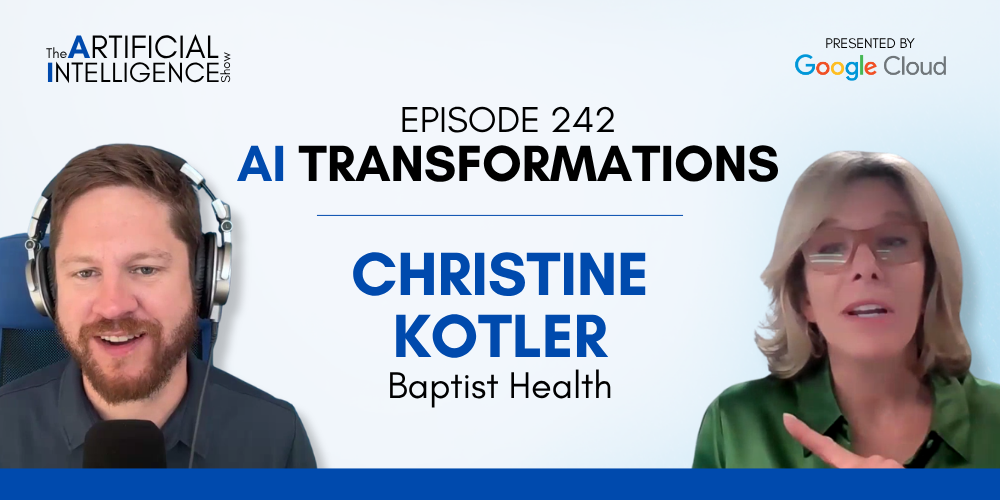
Everyone talks about AI transformation. Far fewer can show what it actually looks like inside a real organization with real constraints. Christine Kotler can.
As CMO of Baptist Health South Florida, she spent two years building an AI adoption model for her marketing and communications team and in this conversation, she walks through the whole arc: the learning curriculum, the peer-coaching model, the wins, and the friction that showed up once the easy part was over.
Listen or watch below—and see below for show notes and the transcript.
Listen Now
Watch the Video
Timestamps
00:00:00 — Intro
00:06:00 — Why marketing & comms took the lead on generative AI
00:10:57 — How the transformation started to unfold
00:14:23 — The AI Sherpas
00:20:12 — The learning hub and building their own AI curriculum
00:22:16 — How AI is changing the marketing/comms team's work
00:28:28 — The people side of the transformation
00:33:02 — Where transformation got messier or harder than expected
00:36:27 — How AI will reshape roles, workflows, and team structure
00:40:08 — Advice for a leader stepping up to lead AI transformation
This episode is presented by Google Cloud:
Google Cloud is the new way to the cloud, providing AI, infrastructure, developer, data, security, and collaboration tools built for today and tomorrow. Google Cloud offers a powerful, fully integrated and optimized AI stack with its own planet-scale infrastructure, custom-built chips, generative AI models and development platform, as well as AI-powered applications, to help organizations transform. Customers in more than 200 countries and territories turn to Google Cloud as their trusted technology partner.
Learn more about Google Cloud here: https://cloud.google.com/
Read the Transcription
Disclaimer: This transcription was written by AI, thanks to Descript, and has not been edited for content.
[00:00:00] Christine Kotler: This was something that was going to truly, fundamentally change how we worked, which was both exhilarating and entirely intimidating at the same time.
[00:00:10] Mike Kaput: Welcome to AI Transformations, a special series from the Artificial intelligence show. I'm Mike Kaput, chief Content Officer at SmarterX and Marketing AI Institute, and I'll be your host.
[00:00:22] Every business's AI journey looks different. In each of these episodes, I sit down with leaders who have lived through real AI transformation, including the actual stories, the pain points that push them to act, the moment things started to click, and the results they can point to today. So join us as we accelerate AI literacy for all.
[00:00:43] As part of our AI transformations series. Welcome everyone to episode 242 of the Artificial Intelligence Show. I am Mike Kaput, co-host of the Artificial Intelligence Show and Chief [00:01:00] Content Officer here at SmarterX. Now, today's episode, you're starting to probably get. Familiar with this is a little different from your regularly scheduled programming.
[00:01:08] It is a special episode in a limited series that we're running called AI Transformations presented by Google Cloud. So in this series we are spotlighting how real companies are driving real change using ai. In each episode, we explore how leaders at some of the world's most innovative companies are actively using AI to transform how their teams, departments, or even entire.
[00:01:31] Organizations work, and we do that by interviewing those leaders firsthand right here on the show, including Christine Kotler from Baptist Health, who is here with me today. Much more on Christine and Baptist in a minute. Just to kind of reiterate for folks who are new to this series in this format, the reason we're doing this in partnership with Google Cloud is simple.
[00:01:55] AI transformation can feel very abstract. Everyone is talking about the [00:02:00] importance of ai, but far fewer people are showing what it actually looks like in practice inside real companies, real teams, and with real constraints and real business outcomes. So the goal of all these conversations is to make AI transformation much more concrete.
[00:02:15] We want you to hear how other leaders are approaching it. What they're learning and what practical lessons you can apply as you think about AI inside your own organization. So with that, let's get into today's episode. Today's episode is brought to you by Gemini Enterprise. Businesses of every shape and size are turning to ai.
[00:02:40] They're learning how to move faster, do more, and improve their performance. But you cannot just hand your data over to any platform. You need a trusted partner with years of experience, and that's where Gemini Enterprise comes in. Gemini Enterprise helps you build sophisticated AI agents that can connect with your business [00:03:00] data while also keeping it protected by world class security and governance, so there's no more compromising between performance and protection.
[00:03:08] You can go get started today at cloud.google.com/gemini-enterprise. That's cloud.google.com. Slash Gemini Dash Enterprise. Now today we are talking with Christine Kotler, chief Marketing and Communications Officer at Baptist Health South Florida. Baptist Health is South Florida's largest healthcare organization with 12 hospitals, more than 30,000 employees, 4,500 physicians and 200 outpatient centers, urgent care facilities and physician practices spanning four counties.
[00:03:46] Now, Christine is here with us today because Baptist Health's marketing. Communications team has spent the past two years building an AI adoption model that began with literacy, then moved into peer support, workflow [00:04:00] integration, tool pilots, and marketing and comms, taking a broader leadership role in supporting the organization's AI journey.
[00:04:08] Now, that journey began way back in 2024 with what Christine describes as a eureka moment about ai. So rather than starting with a broad technology rollout, her team created a customized learning syllabus using outside programs and Baptist Health's HR and IT resources. Then they connected that learning to performance evaluation.
[00:04:29] So AI development became part of the job rather than an optional activity. As the program progressed, the team learned that people did not adopt AI at the same pace. Baptist Health, in fact, identified a group of early adopters called AI Sherpas, then added weekly learning labs, office hours, and AI council, and focused work streams around learning tools.
[00:04:52] Learning tools, use cases, and governance. The department also began running short pilots to determine whether a tool should be [00:05:00] used by everyone, a smaller group, or even no one at all. So the transformation is also changing who leads and what skills matter. For instance, one team member actually came in.
[00:05:10] With a background as a restaurant entrepreneur with no healthcare marketing background, then actually became a leader among the AI Sherpas and began building new solutions around marketing, technology, and enablement. Baptist Health is now developing new roles and job descriptions around. Work like this, and that work is spreading strategy, finance, hr, other corporate support functions have begun joining the learning sessions and asking marketing and communications for help.
[00:05:39] So in this conversation with Christine, we're going to unpack what sparked this transformation, how Baptist Health has built its learning and support system, how AI is changing actual work and what Christine has learned about leading people through this change. Christine, thanks so much for being on the show.
[00:05:55] It's such a pleasure to have you.
[00:05:57] Christine Kotler: Mike, good to see you and glad to be here. [00:06:00]
[00:06:00] Why marketing & comms took the lead on generative AI
[00:06:00] Mike Kaput: So let's kick off by, take us back to 2024 when Baptist Health's marketing and communications team began to seriously engage with generative ai. I'm curious from your perspective, what made it important enough to act on and why did you believe marketing and comms had a role in leading that response?
[00:06:22] Christine Kotler: So. This is late 2024, and it was actually, in a setting where Paul was talking to a small group of very seasoned CMOs. and he goes on for, I don't know, about an hour and a half. and he's talking about this, you know, this thing AI and what it was gonna do and how it was going to literally change the way we work and everything about it.
[00:06:48] And after that. You could have heard a pin drop mic. It was crazy, right? There was this long, uncomfortable silence among some very highly experienced, you [00:07:00] know, battle tested CMOs and. I think it was then, I'm not even sure, you know, why in that moment that there was this realization for at least me. And I think then for us, you know, as a, as a department, after I came back from that session, that this was not just this little, you know, technology thing.
[00:07:20] It was a seismic shift. It wasn't happening far into the future, right? It was happening right now and it was unfolding very, very quickly. So, you know, I think that was the, that, you know, eureka moment. I call it a holy bleep moment, and it was really. recognizing and then acting upon, right? How this was going to change knowledge work, right?
[00:07:47] Creative work, research, decision making team structures. And so, you know, why us, you ask about, you know, why is market, why is like the marketing and communications, discipline, [00:08:00] well positioned to not only understand it and then help. Team and the rest of the organization kind of, you know, work, work through this transformation.
[00:08:10] I think it really comes down to we, in our, in our function, right, we study human behavior. We study right what motivates a consumer to buy our product, right? Use our service. We understand the importance of communicating clearly and effectively to. Bring people along, right. To persuade them, to do something, to take an action.
[00:08:35] And I think that's what makes us, again, you know, uniquely, well-suited to help organizations move through this very challenging. and, and changing, fast changing, right. You know, transformation because we didn't treat it as technology adoption. From the get go, we understood that this was about understanding and [00:09:00] changing human behavior.
[00:09:02] And at least from our perspective in, in marcoms, we really took a very human first, AI forward, kind of, you know, guiding, you know, principle, that has really, you know, fundamentally, you know, guided the work that we've been doing over these past two years.
[00:09:18] Mike Kaput: That's incredible. So it sounds like, so Paul, Paul Roetzer our CEO, here at SmarterX, founder of SmarterX and my co-host on the artificial intelligence show.
[00:09:27] He comes in, gives a talk that sounds like that kicks off basically, for a room full of executives like a, holy crap, this is real. We need to start thinking about what comes next.
[00:09:40] Christine Kotler: Absolutely. And again, I think someone in the audience said, I think you broke our brains.
[00:09:47] Mike Kaput: Yeah.
[00:09:48] Christine Kotler: I reflect on that.
[00:09:50] It was, I just, it was so impactful that, we be, it was shared in such a way. [00:10:00] That it was deeper than, you know, this is just another new, you know, again, you know, technology and our tech stack. We're very comfortable with that in marketing and technology, but we just didn't, I think, have, at least I did not understand the widespread impact that.
[00:10:19] Again, in this case, you know, Paul had a view all for many years of studying it, but the rest of us only saw as, you know, again, either sci-fi or something that, you know, computer geeks did, you know, in a lab somewhere. Yeah. and we really, it, it made it, I think. accessible to us, right? That this was something that was going to truly, fundamentally change how we worked, which was both exhilarating and entirely intimidating at the, at the same time.
[00:10:51] And that is a very true, right, those two, those two feelings, I'm co-exist every day.
[00:10:57] How the transformation started to unfold
[00:10:57] Mike Kaput: Yeah. No kidding. [00:11:00] So I'm curious, once you have this kind of direction, it sounds like. In, in such a great way. After that talk, everyone's kind of understanding that this is a, an immediate, urgent priority. I'm curious, can you walk me through maybe how did transformation start to unfold?
[00:11:15] You know, you, you'd started building AI literacy, started changing how the team works. Maybe give us kind of the main beats there and talk us through where do things stand today as well.
[00:11:26] Christine Kotler: Sure. So after that, you know, holy bleep moment, we did start putting things together and from this. Start, we were very deliberate about a structured learning journey.
[00:11:40] I think, I think, you know, there was, you know, a lot of change. lots of, you know, new ideas and new ways of, you know, using ai, it's coming at you in a rapid fire pace. And you could either, you know, throw a bunch of tools at people and, you know, hope for the best. And fingers crossed we were much more.[00:12:00]
[00:12:00] I think I'm deliberate about how we were going to structure the learning journey. And so what does that look like? At least in our case, we developed a year long AI curriculum. think of it like a, a learning syllabus, right? That you would find, you know, in a, in a college course. That was supported both by external learning modules, internal lunch and learns, webinars, things that were also provided by IT and hr.
[00:12:28] And we also carved out dedicated time in in the workday for people. To practice on some of these new tools. To take the classes Right, to listen to the podcasts, to have a, a watch party. Right. You know, when things were, you know, when major, you know, like keynotes were happening. So that was the very beginning of that year long,
[00:12:51] curriculum. As we began to move through that year, we also identified the need for some, like, I'll call them [00:13:00] wraparound services. And that was, having our own department specific AI council that has a direct link to the enterprise wide AI Council. We also developed marketing and communication specific usage guidelines, right, to use things responsibly, safely.
[00:13:18] we also. established AI learning labs, right? So we have biweekly AI learning labs where we do a deep dive on a particular tool or an application. office hours, a dedicated Slack channel, a learning website, like a hub, right? And I could talk a little bit more about that. You know, how we built that out for, again, marketing and communications specific, you know, applications, use cases and resources, and.
[00:13:47] You mentioned, you know, in, in sort of the intro, we developed a small team of AI Sherpas.
[00:13:55] Mike Kaput: Mm.
[00:13:55] Christine Kotler: and these were more tech enabled helpers, if you will, [00:14:00] that were just more comfortable kind of. going out in front and, and helping others along because as you mentioned, people had, varying degrees of comfort, and as they built their confidence along this learning journey and, those AI sherpas have been kind of key to our success.
[00:14:23] The AI Sherpas
[00:14:23] Mike Kaput: Can you talk to me a little bit more about the AI Sherpas? I wanted to ask you if there was kind of a particular unlock moment that stands out in this transformation journey. If there are others, please share them. But it sounds like the Sherpa, especially as you and I have talked, were just so critical in moving things forward.
[00:14:40] Christine Kotler: We didn't know what we didn't know. And that's sort of the, you know, the, I think that the theme of sort of, yeah, I think any type of, you know, major transformation. The AI Sherpas, as we lovingly call them, right? That name, that name is very intentional. Because when you think about, you know, [00:15:00] Sherpas in the, in the, you know, climbing world, they bring experience, they bring judgment, right?
[00:15:06] They bring a practical knowledge. they carry some of the load along the way. They anticipate problems. They help define the best route to make that climb more achievable. So apply the same principles, right, to this type of transformation, disruption, and learning journey. We don't want people right to just, you know, rely on someone else to use ai.
[00:15:35] To build things, right, to change workflow designs. We want them to learn how to use these tools themselves, and increase their competence and confidence, right, and their capabilities along the way. And I think. By defining these AI Sherpas, right? These were people again, who were just more tech savvy and they gravitated to, [00:16:00] these new tools and the speed and, you know, kind of, again, seismic changes that were happening.
[00:16:08] They were comfortable with that and they were able to sit at the elbow of others who were less comfortable or who had anxieties or who just needed somebody to say, like, show me how to do that. And. That group. you know, while it was loosely defined, yeah. At the very beginning of our learning journey, we really have more, I think, definitively said this is their role.
[00:16:36] Mike Kaput:
[00:16:36] Christine Kotler: And this is how they can help others. And initially, right, they were testing new tools. They were serving as tutors, right, as I mentioned, and they were clearly out ahead of others Now. Where we're like kind of restructured that approach where we've evolved the structure of how we use them, the AI Sherpas, you know, a team may have a challenge, right?
[00:16:59] A [00:17:00] business challenge or they're, you know, stuck on how to apply AI to redo a workflow. And they come to the Sherpas, they work on the problem together, and the Sherpas give advice, right? They show them how to, right. Climb that mountain and then that team goes off, builds a little, comes back, they get a little bit more help.
[00:17:25] So it's much more iterative and supportive rather than, Hey, go do this for me. And that has been, a really, really successful model for us where again, we're pointing people toward the better solutions and teaching them how to navigate with AI on their own.
[00:17:48] Mike Kaput: So it sounds like the Sherpa, the AI leaders in the organization who are kind of helping others along came for, there were kind of people that were just experimenting or [00:18:00] engaged with the technology and raising their hand.
[00:18:02] I mean, I think I had mentioned in the intro and when we had chatted before the episode, you actually told me someone. Kind actually, this came from a restaurant entrepreneurship background rather than healthcare, marketing or tech, but became extremely AI savvy. Is that something you were seeing across the backgrounds of these AI Sherpas?
[00:18:19] Just, it didn't really matter. Exactly what competency you had had previously in tech or in marketing, but it was more about what you had evolved into with AI literacy and experiments and engagement.
[00:18:31] Christine Kotler: I think, Mike, that was something that, again, these are all these lessons learned as we go and grow. That, that type of right.
[00:18:42] Agile mindset, maybe even, you know, would be considered an entrepreneurial mindset.
[00:18:47] Christine Kotler: With something, you know, that is driven by, I think they're resourceful. that curiosity. Right. You know, how does this work? What does this do? How can I make something better? [00:19:00] those were. Skills or traits, right, that I think we didn't recognize at the beginning.
[00:19:07] You, I think the assumption is, oh, I'm gonna go talk to my, you know, my team that mainly focuses on, you know, marketing technology. And yes, those folks were definitely much more comfortable. But what we didn't truly recognize from the beginning that that. Mattered less. It was more about did the individual or individuals really just have a desire?
[00:19:33] Right? and, and maybe it was a little bit of that fearlessness, right? That comes from being an entrepreneur. They didn't have perhaps some of the same anxiety, or, you know, concern that someone else might. that has a much more traditional mindset that. Type of, I think, and that's where we think about developing the talent of tomorrow.
[00:19:55] How do we cultivate more of that so that [00:20:00] entrepreneurial, agile mindset, gets recruited, right, nurtured, and developed even further as we build out the team. I think that's gonna be critical.
[00:20:12] The learning hub and building their own AI curriculum
[00:20:12] Mike Kaput: Before we get into some of the concrete examples about how AI is changing work at Baptist, can you talk to me just a little bit more about that learning hub you mentioned, just so I can set the stage for people about what you've kind of built this, you've gone much more extensively down the road of building your own learning journeys and curriculum.
[00:20:30] Then many organizations have it sounds like.
[00:20:33] Christine Kotler: Absolutely. So. We have this, right? It's internal for marketing and communications. We've given other right, of, departments and, and functions that we've been sharing our journey with access to it. And it's really, think of it, you know, we've just aggregated a bunch of different resources from podcasts and white papers and, you know, cool LinkedIn posts, learning [00:21:00] modules.
[00:21:01] Everything imaginable. Our own use cases, the successes and failures and the whys behind that. This is all in one learning hub, that marketing and communications as a team, we have access to that. We can go in and also share our learnings. throw out a new idea, a new use case. That is something else that we have been, I think, much more deliberate about.
[00:21:27] At the very beginning of our excitement and enthusiasm around ai, we were building all sorts of stuff, right? And some of it had utility and some of it got thrown in the trash, and we didn't want to squash enthusiasm along the way. We wanted to channel it much more, you know, again. Directly, and with guidance.
[00:21:50] And so that hub also, you know, creates that opportunity for, Hey, if you have a new idea, let's discuss it. Let's pick it [00:22:00] apart and make sure that it has, you know, perhaps does it have, you know, application for all or does it really have, you know, utility for a specific team or, or problem. And that has just become a great, great resource for us.
[00:22:14] Mike Kaput: That's incredible.
[00:22:16] How AI is changing the marketing/comms team's work
[00:22:16] Mike Kaput: So let's talk about some concrete examples of how AI is changing the work of Baptist health marketing and comms team. I'd just be curious if any examples you can share of, okay, we've done all this AI literacy, we're learning, growing, evolving together. What kinds of things are we able to do now with ai?
[00:22:37] Christine Kotler: So a couple of, I think, you know, are top of mind. I'll give you one that's, that's now been built for one team, but now has application across the entire team. So online listings in, in healthcare, right. And we have many, many locations and providers and online listings are a way right, of connecting people [00:23:00] to find the services and physicians and providers that they're looking for.
[00:23:03] And they need constant updating, in order to be accurate. Once upon a time, not that long ago, this was a person's, you know, a big part of a person's job and that was across different teams on, you know, in the department to go in there, you know, 10 hours a week sometimes to manually look for problems.
[00:23:29] Make the corrections, update it. And this is across all these different, right, you know, online, you know, dozens of sites and platforms. It is highly, highly manual. Fast forward, and this was a classic example of the client facing team came to the AI Sherpa and said, all right, we need to solve this problem.
[00:23:54] Help me understand. The best way to do this. And so they began, you know, and it took them a [00:24:00] couple of weeks to make sure that all of right, the data sources were connected and that it became much more automated.
[00:24:08] Christine Kotler: And just about a week ago, they unveiled right, this big reveal of this beautiful dashboard that is entirely automated.
[00:24:18] And that what once took somebody about 10 hours every week. Now takes about two minutes
[00:24:26] Mike Kaput: Wow.
[00:24:26] Christine Kotler: To just take a look with, you know, red, yellow, and green dials. Right? It is just this very visual, highly automated approach to online listings management. And now we're gonna take that and, put that across right?
[00:24:45] Imply that to all the other teams that manage listings. So that is one great example of not only changing, right, completely changing how we do that work, but also just [00:25:00] reducing, right. You know, it's about efficiency, but it's also taking that person, and you guys talk a lot about this, right? And applying her talents to the higher value work,
[00:25:10] Mike Kaput: right?
[00:25:11] Christine Kotler: That was not a great use of a very talented individual, right? From doing this Excel spreadsheet driven, you know, update. Every week. And now we actually can repurpose her talents, you know, to something you know, much more, you know, valuable and useful. So that's one example. Another example we have is in our creative services department, right?
[00:25:31] We do hun thousands of jobs every single year, and a lot of those jobs can be templated. And so using something like, we use our, we're an Adobe shop, so we use Adobe Express. What we did there was, our creative services leads, right? The graphic designers who have, taste, they have a lot of skills in terms of what things should look like on [00:26:00] brand.
[00:26:01] They created templates that could then be automated and used by the client facing account teams. Again, we used to have a huge bottleneck and a backlog in our creative services function because they're just. Hundreds of jobs that are being pushed through a limited number of resources there. Now, we've actually created a self-service model and pushed that out to the account teams where they can absolutely turn things around.
[00:26:30] Again, using the guiding principles, the brand standards, but moving that through, that work through much more quickly. And accurately importantly, there's still a human at the end of that, right? Making sure right, that it's, that it's approved, but that has absolutely reduced the burden on the internal graphic design team.
[00:26:54] From my purview. Right. I'm looking at it. It also reduced the reliance on [00:27:00] external freelancers.
[00:27:01] Christine Kotler: And that has been a cost savings for us. So there was, you know, time, efficiency, speed, a cost savings and just the reduce of the wear and tear. On the team itself.
[00:27:13] Mike Kaput: Yeah,
[00:27:13] Christine Kotler: so that's another really great example that you know, we use it all across.
[00:27:18] There are dozens of other examples of how AI is not only used, but changed the work from research analysis and script writing and content development and creative development. The list goes on, but I think the main point I would wanna get across is it's not just about right, you know, faster work. We're really focused on delivering better work.
[00:27:39] And then freeing up, right. That talent where they can have a greater impact.
[00:27:44] Mike Kaput: I love that. That's such a tangible, practical way to think about AI transformation. Like I would encourage anyone listening, I mean, you do not have to like boil the ocean all at once, right? There's these really narrowly important strategic things that [00:28:00] can be assisted or augmented or automated with AI that can transform your organization even if they.
[00:28:07] Don't sound like, you know, reinventing how healthcare works with agents. Right. Which is coming, probably coming, but you know, but it is this stuff not too far from now, I'm
[00:28:16] Christine Kotler: sure.
[00:28:16] Mike Kaput: Right, right, right. But you're saving literally dozens of hours per month per person, per task over an organization of your size.
[00:28:24] That's nothing short of transformational.
[00:28:28] The people side of the transformation
[00:28:28] Mike Kaput: So I'm curious, let's talk about, outside of the tech and the use cases, what did the people side of this transformation look like? We talked about, you know, the ai Sherpas are raising their hand to lead people, but I'm curious how different employees responded to ai.
[00:28:45] Did you have to put things in place to help them build confidence, adopt it, begin working differently?
[00:28:52] Christine Kotler: Mike, I think that's my favorite question because that's actually for me, what has [00:29:00] mattered most, right, is the impact for people and how we have been supporting people through this massive change.
[00:29:09] And that not only goes for right marketing and communications and the department I lead, but how I can assist in my role as CMO, the whole organization. And. I think that has been something that, that has been where the greatest learning has happened because, you know, for starters, you know, people are unpredictable.
[00:29:30] And humans are humans, right? And from the beginning, right. Some employees were really eager, as you described. Some were very cautious, some were highly skeptical, and. I forgot to mention right when we started this, we started with surveys, asking people, talking to people to get a baseline of where they were.
[00:29:51] Christine Kotler: And we continue that on a quarterly basis, not just about, alright, their feelings around ai. And we're already seeing that, you know, [00:30:00] tremendous, backlash societally. Those are the same people who show up, right? And we're asking to use these tools to do work. I also think that looking back, as I kind of reflect on our, you know, evolution through this, I think I misunderstood or perhaps even misinterpreted reluctance and resistance that was being perhaps, you know, displayed by some as that was actually pride.
[00:30:34] I think you and I have talked a little bit about it. It's really pride of ownership. It's pride of expertise, right? When people have built deep subject matter expertise over the course of their careers, and they really care about their craft, that's something I love to see right. In the people. I have the, you know, privilege of leading and it's a really important thing about bringing that type of pride to [00:31:00] work.
[00:31:00] So it's understandable when they would. Be resistant to, you know, allowing some machine, right. Like to do that work for them. And that was a really important insight and something I think as a, as a leadership team that I think we kind of underestimated and needed to kind of go back. Find other ways to be more supportive, visibly supported, reminding people that this was, you know, a journey together.
[00:31:31] I also wanna be clear, we were also, we set clear expectations. You mentioned it, you know, we linked this to performance conversations and then performance evaluations. This wasn't optional. But what we had to understand is we had to flex a bit, right? And be, I think more empathetic in terms of understanding how people were moving through this.
[00:31:58] [00:32:00] and that peer coaching, right? Those Sherpa leadership, visibility and support have been key to. I think helping people feel right that this was something that they weren't alone, you know, on this journey. That this was, you know, much more of a, of a team sport. and as our own progress, right, as a team, and we were talking about, you know, our successes and failures very, you know, very candidly, that's when other teams across the department began to kind of tap on our shoulder and ask for help.
[00:32:37] I turned that into an opportunity to show our own team, Hey guys, this has been hard. But we are being recognized as, as leaders here. And that was another source of Right, you know, a point of pride that they got excited. Like, oh, we know this, right? We've been learning this. We're a little bit ahead of everybody else and we can help bring others along [00:33:00] across the organization.
[00:33:02] Where transformation got messier or harder than expected
[00:33:02] Mike Kaput: I really appreciate your candor about that. I'm curious. playing on that. Are there any other areas where the transformation has been messier, harder than expected? especially too, I know healthcare is not without its own unique challenges in terms of privacy, data, et cetera. I'm curious if you could unpack some of that for us.
[00:33:26] Christine Kotler: So, you know, when we said year one was all about literacy, learning and competency, year two. Has been a little bit more challenging for a few key reasons. and I would say it's more about how we're now optimizing and integrating, right? Really connecting all of these tools we now have built. And that has been a point of frustration, right?
[00:33:55] That friction where we can't. I think [00:34:00] seamlessly connect some of these things inside marketing and communications for some of those very, you know, valid reasons of, you know, there are all sorts of security concerns and data concerns. I am one that has been advocating for and continue to do so that, in a highly regulated right industry, like, like healthcare, we have to bifurcate perhaps, you know, the clinical things that should go slow and perhaps business or corporate support functions like marketing, who should be put into like the fast track and enable us to move more quickly because as it relates to our own teams.
[00:34:40] frustration, right? Where it's getting a little bit messier or harder is they're feeling a bit like they're in quicksand, right? We built this stuff, we're ready, right? You know, we need to use repin and start connecting things and we get pause, stop delayed, [00:35:00] right? To go through layers and layers of approvals and, and governance reviews.
[00:35:07] Understandably, there are, those rules are put in place for, you know, really good reasons, in healthcare, and we have to find ways, to, I think, you know, free up a fast, you know, a fast track. I think that is something that, I recognize right as I have these enthusiastic, you know, users of ai. That as an organization, we have to think very carefully about that.
[00:35:42] because this talent won't sit tight. They won't wait. And I talk about it with my colleagues or I, you know, my colleagues in HR and my colleagues in it to say. We have got to find a way to create lanes [00:36:00] that are appropriately slow and appropriately fast because the talent that we want to keep won't sit here and wait forever, while we slowly go through, you know, a monthly review of tools and governance and reviews and security checks.
[00:36:17] They just won't. And we're going to end up losing those folks if we don't find ways to speed things a little faster.
[00:36:27] How AI will reshape roles, workflows, and team structure
[00:36:27] Mike Kaput: So as Baptist is entering kind of this next chapter of work driven by ai, I'm curious how you're thinking about AI's potential to change roles, workflows, structures of marketing and communications as an organization.
[00:36:45] Christine Kotler: I'm going to confess, I do not have all of this figured out. We've actually been more challenging than I thought, and I think a bit of that comes from, let's [00:37:00] say the humans, right? When you ask folks to reimagine their team, to reimagine workflows, it is natural that they reimagine it through the lens, the human perspective.
[00:37:17] Christine Kotler: And so when we start talking about the use of agents and, you know, teams of agents, people become very concerned about like, well, where do I fit in all of that? It goes back to again, what you both talk a lot about, you know, on the podcast is you know that the real threat of, you know, of.
[00:37:40] You know, my own job or what, what is going to be the impact to me or to the team? With that said, we are really looking at, new job descriptions that AI Sherpa now is, a marketing technology transformation and [00:38:00] enablement role.
[00:38:01] Mike Kaput: Okay.
[00:38:03] Christine Kotler: We are now developing even more job descriptions that will have, that will require I think, more of that, you know, AI forward, you know, design and utilization and connection.
[00:38:20] But one of the things that I think has been most challenging to me is that because we're starting with traditional structures. It is very hard to build an AI native Right. Team or workflow.
[00:38:36] Mike Kaput: Yep.
[00:38:37] Christine Kotler: And I didn't really appreciate that you guys have talked about it. I didn't really understand it until we get there and we're whiteboarding it and we're trying to figure it out, and we have either roles or people's names right in that workflow, and now we're being much more deliberate to say.
[00:38:57] Let's talk about the function [00:39:00] and how AI can do that thing or set of things. And then how, where else does a human right? Where else in that workflow process is a human actually needed and, and for what? That is something that is unfolding as we speak. We have not figured it out, but I know that that is, I think, in this next wave, right in year three of our AI journey, that's really where I think the rubber meets the road for us.
[00:39:32] And I hope, I hope I get to come back and tell you, right. We've got it all solved. I don't know if that'll happen, but I do think that is our next area of focus is truly how to. We've been working on team transformation as part of this technology transformation. I think we need to accelerate that more, and that is really gonna come back to workflow redesign with AI built into that [00:40:00] kind of principally, and then humans in other roles along that, you know, along that process.
[00:40:08] Advice for a leader stepping up to lead AI transformation
[00:40:08] Mike Kaput: So, Christine, as we wrap up here, curious if you have any final advice that you give another leader who wants to maybe step up or continue stepping up to help lead AI transformation in their organization?
[00:40:23] Christine Kotler: The very first thing I would say to another leader is you gotta go first. You gotta just jump in there and, dive in to the deep end.
[00:40:35] Leaders model that behavior and they cannot outsource their own AI literacy. if you want your teams to be fully engaged, and then you gotta do the exact same thing and, and start with that baseline, right? Understanding how people feel, what their reluctance or resistance is. [00:41:00] what they're anxious about talking to people.
[00:41:03] I spend a lot of time just asking people, how's it going? give people real tools, real rules, time to learn visible support. That was one of the things we have had to go back and, reignite and reengage. Sometimes the, I would say. Our early career professionals were off and running and they were excited and they were using all these tools and you know, perhaps somebody who had a few more years under their belt was a little bit slow reminding leaders that this is a fundamental part of leadership.
[00:41:49] even if they don't have all the answers right, and none of us does. That is, you know. No one has all the answers. Even you guys talk [00:42:00] about it as long as you have been studying this every day, right? Something new comes along, some new capabilities, some new challenge, and we don't have all the answers.
[00:42:11] And I think that's part of the vulnerability of being a leader is saying like. I don't have all of this figured out, but together, right. We're gonna go on this journey. And I think being patient, being empathetic, setting those clear expectations, being enthusiastic, maintaining that enthusiasm. We've also seen that along the way, right?
[00:42:35] First year, super excited. Second year, they're like, oh my God, we have more AI to do. And we're like, I'm like, yep. It's never ever gonna go away. Making sure people understand, right. Why are we doing this? It's not to produce more work or just to save money or be more efficient, it's really about right. That same pride of craft, right?[00:43:00]
[00:43:00] We love what we do at Baptist Health. We have a purposeful mission to serve. Imagine having more time. To do that, right? To apply your talents and your energies to the work that matters most. Keeping that at the forefront, I think has been key to our success too.
[00:43:22] Mike Kaput: I love that. What a positive, encouraging note to end on.
[00:43:25] Christine, thanks so much for sharing Baptists ongoing AI transformation story with the audience. We really appreciate it.
[00:43:32] Christine Kotler: It's been such a pleasure and it's been a fun journey and it, and it still goes on.
[00:43:36] Mike Kaput: And thank you to everyone tuning in. We really appreciate you following along and supporting this series.
[00:43:41] We've got more to come on this in the coming weeks and months, and in the meantime, until our next episode. Thanks for listening. Appreciate it. Thanks for listening to our AI transformation series from the Artificial Intelligence show. To keep learning, visit SmarterX.ai where you'll [00:44:00] find on-demand courses, upcoming classes, and practical resources to guide your AI journey.
Claire Prudhomme
Claire Prudhomme is the Marketing Manager of Media and Content at the Marketing AI Institute. With a background in content marketing, video production and a deep interest in AI public policy, Claire brings a broad skill set to her role. Claire combines her skills, passion for storytelling, and dedication to lifelong learning to drive the Marketing AI Institute's mission forward.