
Our latest AI Pulse survey, taken by listeners of The Artificial Intelligence Show, highlights a critical tension in the AI adoption curve: the gap between professional utility and personal privacy.
According to the data, which polled 85 professionals, the vast majority of respondents are hesitant to embrace OpenAI’s new ChatGPT Health interface. Despite the promise of personalized health insights, less than one in five respondents expressed a clear willingness to connect their medical records, signaling that trust, not capability, is now the primary barrier to adoption in high-stakes domains.
The Privacy Barrier to AI Health
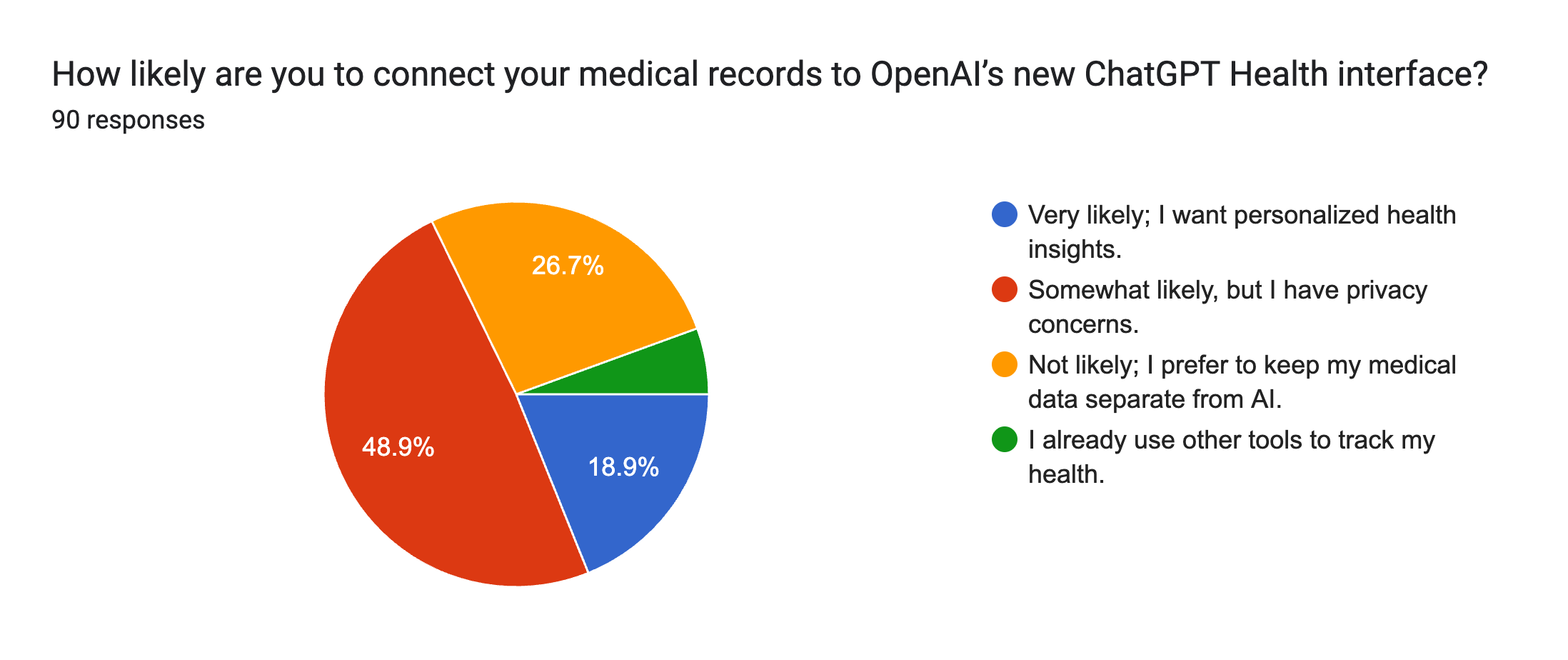
When asked directly about their likelihood to connect medical records to the new ChatGPT Health interface from OpenAI, the audience’s reaction was overwhelmingly cautious.
Only 18.8% of respondents said they were "Very likely" to do so.
The remaining respondents were split between skeptical interest and outright refusal:
- 48.2% said they were "Somewhat likely," but explicitly noted they have privacy concerns.
- 28.2% said they were "Not likely" and prefer to keep their medical data separate from AI.
- 4.7% noted they already use other tools to track their health.
When combined, 76.4% of this audience, a group that is generally pro-AI, expresses significant reservation about sharing sensitive health data with an AI model.
Caution Reflects a "Pragmatist" Mindset
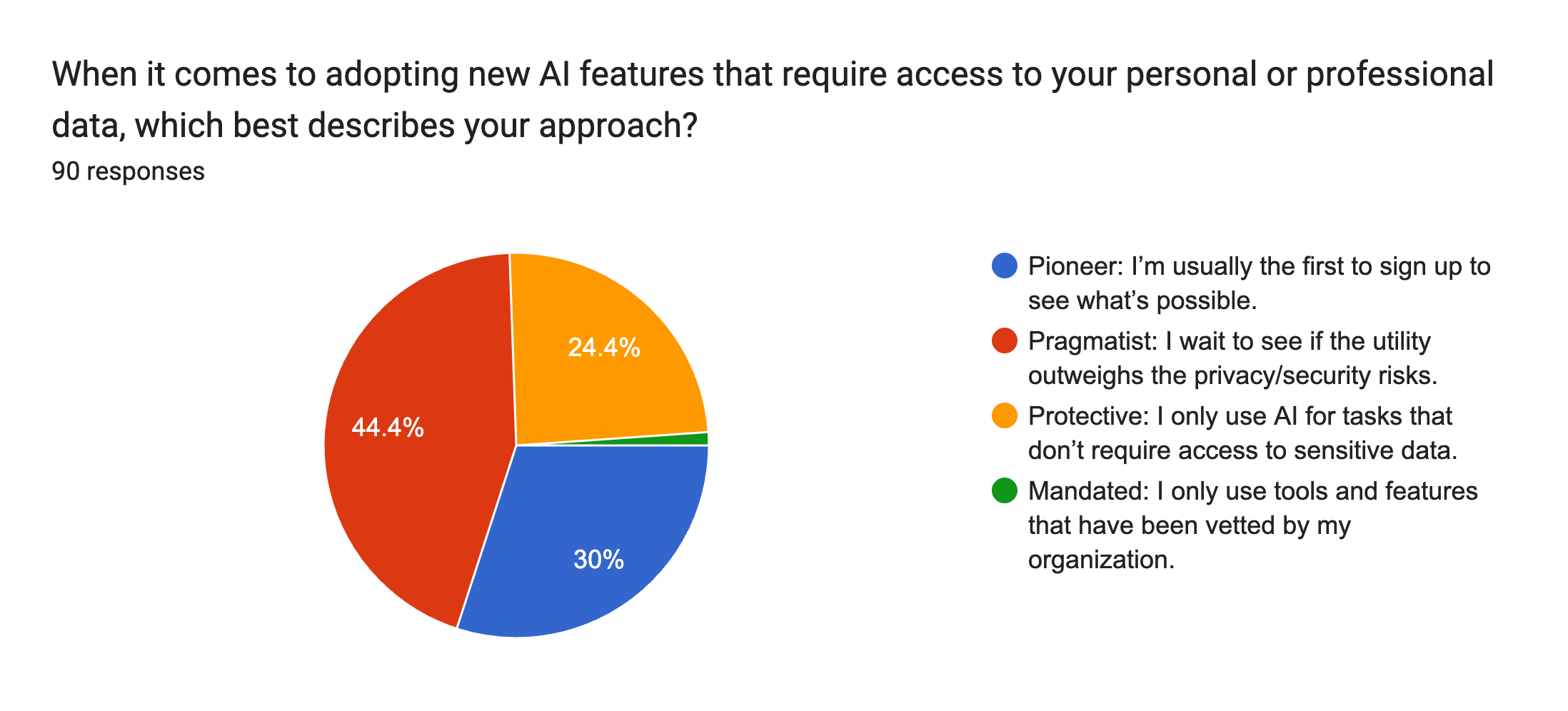
This hesitation aligns well with how this audience now defines its overall approach to AI adoption. We asked respondents to categorize their mindset when adopting features that require personal data.
The largest group, 44.7%, identified as "Pragmatists," defining their stance as: "I wait to see if the utility outweighs the privacy/security risks."
The rest of the field was divided:
- 28.2% identified as "Pioneers" (usually the first to sign up).
- 25.9% identified as "Protective" (only using AI for tasks without sensitive data).
- 1.2% selected "Mandated" (using only vetted organizational tools).
The dominance of the "Pragmatist" persona explains the ChatGPT Health findings: users are waiting for the value proposition to clearly justify the privacy risk.
Contrast: High Adoption for Coding Tools
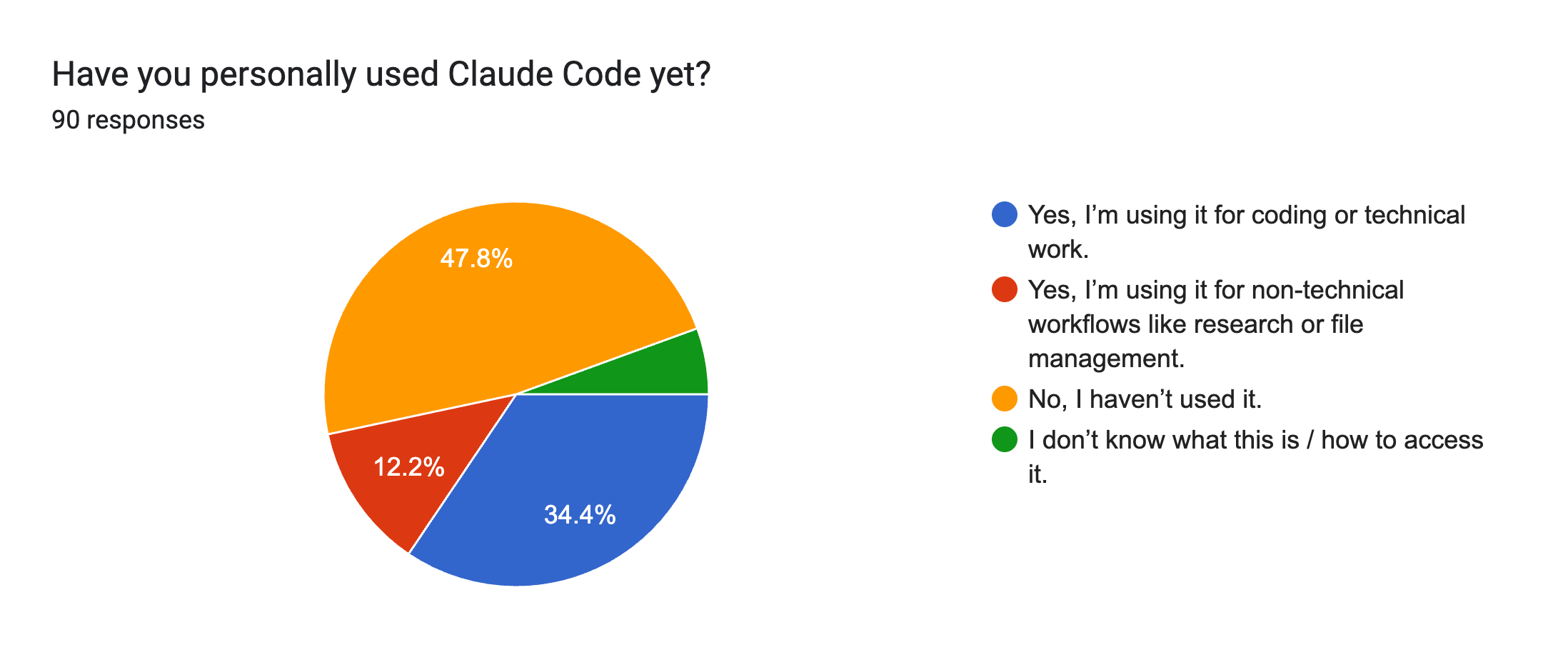
As part of this past week’s survey, we also looked at adoption rates for Claude Code, a tool used primarily for professional output. We found that:
- 34.1% are already using it for coding or technical work.
- 11.8% are using it for non-technical workflows.
- 48.2% have not used it yet.
- 5.9% didn't know what it was.
With 45.9% of respondents actively using the tool, adoption for professional tasks is more than double the unconditional readiness for health data integration (18.8%).
Methodology and Audience Description
In our ongoing AI Pulse surveys, we gather insights from listeners of our podcast to get a sense of how our audience feels about various topics in artificial intelligence. Each survey is conducted over a one-week period, coinciding with the first seven days after an episode is released. During that time, our episodes typically receive around 11,000 downloads.
Our survey results reflect a self-selected sample of listeners who choose to participate, and typically we receive a few hundred responses. While this is not a formal or randomized survey, it offers a meaningful snapshot of how our engaged audience perceives AI-related issues.
In summary, when you see percentages in our headlines, they represent the views of those listeners who chose to share their opinions with us. This approach helps us understand the pulse of our community, even if it doesn’t represent a statistically randomized sample of the broader population.